

Security Concepts & Threat Analyses16 min read
Comprehensive Safe-Deposit Box System Security Requirements: Planning for Maximum Asset Protection
Protecting assets in safe-deposit box systems requires a thorough understanding of complex security requirements. This article examines the decisive factors and standards essential for protecting sensitive valuables, and shows how independent planning minimises risk.
The security requirements for safe-deposit box systems comprise structural, mechanical and electronic measures, defined through comprehensive risk analyses and compliance with relevant standards such as VdS 2349, DIN EN 50131 and VdS 2311. Independent planning is essential to ensure a tailored, legally compliant and future-proof security concept that maximises protection against burglary, robbery and manipulation.
Strategies and standards for protecting sensitive assets in modern safe-deposit box systems
Protecting assets in safe-deposit box systems requires a thorough understanding of complex security requirements. This article examines the decisive factors and standards essential for protecting sensitive valuables, and shows how independent planning minimises risk.
Key Takeaways
- A comprehensive risk analysis is the foundation of every effective security concept for a safe-deposit box system, identifying specific threats and enabling tailored protective measures.
- Compliance with relevant standards and guidelines such as VdS 3868, DIN EN 50131 and VdS 2311 is essential for technical functionality, legal compliance and acceptance by insurers.
- Manufacturer-independent planning by experts such as PLANATEL® ensures the selection of optimal, future-proof solutions and minimises dependence on manufacturers as well as long-term costs.
Whether for financial institutions, businesses or private investors, protecting sensitive valuables against theft, manipulation and unauthorised access is of the highest priority. An effective security concept for safe-deposit box systems goes far beyond simple locks and requires a holistic view of structural, mechanical and electronic protection systems. The complexity of the threat landscape and the need to meet legal requirements as well as recognised guidelines make sound, manufacturer-independent planning essential. PLANATEL® supports you in meeting these challenges and establishing the highest possible level of security.

Fundamentals and legal framework for safe-deposit box systems
Planning safe-deposit box systems begins with a clear understanding of the fundamental security principles and the relevant legal framework. In Germany, Austria and Switzerland, the requirements for safe-deposit box systems are based on a combination of national laws, sector-specific guidelines and recognised technical standards. A central document is the VdS information sheet 3868, "Operation and protection of rental compartment systems/safe-deposit box systems", which provides a comprehensive overview of the various types of systems and their possible security measures. This information sheet, last updated in January 2026, establishes that operators must carry out a risk analysis to ensure the required level of security for the stored assets.
Alongside these specific guidelines, general standards for hazard alarm systems are also important. These include DIN EN 50131 for intrusion and hold-up detection systems, which defines various security grades (Grade 1 to 4), with Grades 3 and 4 relevant for banks and high-security areas. Equally important is DIN VDE 0833-3, which sets out provisions for intrusion and hold-up detection systems and applies together with DIN VDE 0833-1 and the DIN EN 50131 series of standards. For video surveillance systems, the VdS 2366 guidelines are decisive, setting minimum requirements for planning, installation, operation and servicing. Compliance with these standards and guidelines is critical not only for technical functionality but also for legally compliant protection and acceptance by insurers. Sound planning takes all these aspects into account from the outset, to avoid later rework and the associated costs.
Structural and mechanical security: the foundation of the safe-deposit box system
Physical security forms the foundation of every safe-deposit box system and begins with the structural design of the strongroom or security cabinets. Under VdS guidelines 2450 and 2451, these valuables containers must meet high requirements to protect the stored assets against burglary. A strongroom should be secured by burglar-resistant walls, ceilings and floors, as well as a certified strongroom door whose construction should meet at least resistance class RC 4 under DIN EN 1627. These structural measures are decisive in making access more difficult, or impossible, for professional perpetrators who, for example, drill through walls or ceilings. Recent cases of safe-deposit box burglaries show that perpetrators often gain access to strongrooms via basements or neighbouring buildings, underlining the need for robust structural security.
Within these protected areas, the actual safe-deposit boxes are deployed. Here, the quality of the security cabinets and the individual box doors is of great importance. Modern safe-deposit box systems, as used for example in the banking sector, consist of modular blocks with boxes of various heights. The box doors are often made of solid sheet steel and fitted with high-quality stainless steel fascias. VdS information sheet 3868 notes that rental boxes are generally to be regarded as simple containers, unless they are transport containers in automated systems, which likewise offer no qualified mechanical burglary protection. Integrating these containers into a certified security room or security cabinet is therefore essential. Planning must ensure that the entire construction, including any openings for automated input and output systems, meets the highest security standards and is VdS-recognised.
Electronic monitoring systems: intrusion detection and video surveillance
In addition to physical security, electronic monitoring systems are indispensable for comprehensively protecting safe-deposit box systems. Intrusion detection systems (EMA) play a central role here. Under VdS 2311 and DIN EN 50131, intrusion detection systems must be planned and installed by certified installer firms so that they reliably detect and report burglary attempts. For high-risk areas such as safe-deposit box systems, the use of a VdS-recognised intrusion detection system to VdS 2311, class C-SG5, is generally required. This class offers enhanced protection against attempts to overcome the system and extensive monitoring of security-relevant functions. The intrusion detection system must monitor not only the strongroom itself but also all access routes and potential weak points, such as openings for conveyor technology in automated systems. Monitoring of safe-deposit boxes for unauthorised opening should generally be considered and can also be retrofitted to existing systems.
Video surveillance systems (VÜA) complement intrusion detection systems and serve visual monitoring and alarm verification. The VdS 2366 guidelines set minimum requirements for the planning, installation, operation and servicing of video surveillance systems. For safe-deposit box systems, it is essential that the cameras offer high resolution, so that details can be recognised or even identified (VdS class 2 or 3). Cameras must be positioned so that all relevant areas are captured, in particular access rooms and the rental compartment area (outside privacy areas). A video security system not only protects the stored assets but also protects staff and helps investigate incidents. Integrating video surveillance into an overarching security management system enables a fast response to alarms and efficient coordination of security personnel. Transmitting alarm signals to an emergency and service control centre (NSL) is a critical part of the security concept.
Access control and identification management
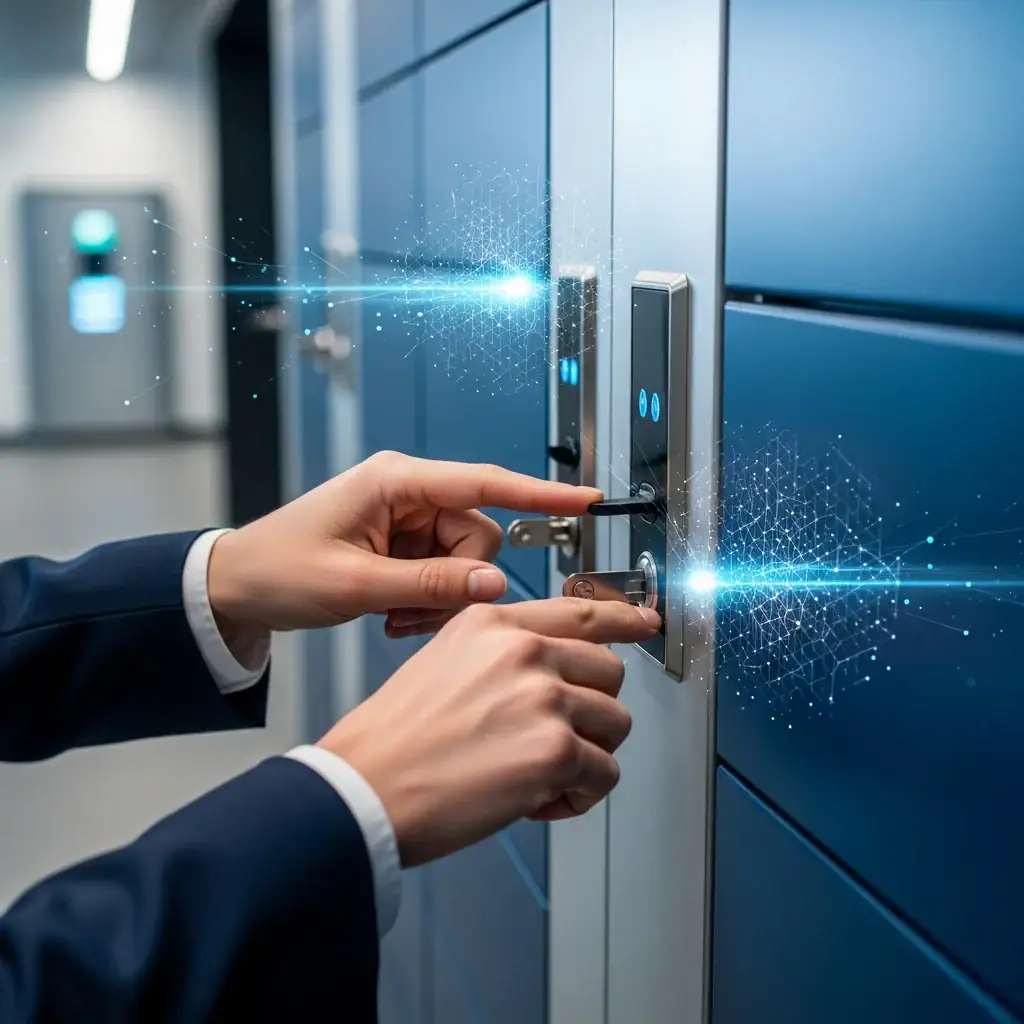
A robust access control system (ZKS) is essential for safe-deposit box systems to ensure that only authorised persons gain access to the valuables containers. The VdS 2358 guidelines for access control systems define the requirements for such systems, covering identification features (e.g. numeric/character combinations, biometric features), identification feature carriers (e.g. keys, chip cards) and input devices. Modern safe-deposit box systems use multi-stage access control systems that can include electronic access cards, PIN code entry or biometric recognition methods such as fingerprints. Authenticating the user is particularly important to prevent unauthorised use of the system with high priority.
When planning access control systems for safe-deposit box systems, various operating modes must be considered, ranging from purely staff-operated systems to partially or fully automated 24-hour self-service safe-deposit box systems. In self-service systems, authentication is a particular focus. Here, after successful identification and authorisation, the requested rental compartment is electronically "pre-locked" so that only that compartment can be opened. Any further opening of another compartment would trigger an alarm. Tamper-proof logging of all access events and compartment openings is essential to ensure traceability. Integrating access control into an overarching security management system enables central control and monitoring of access rights and a fast response to unauthorised access attempts. Compliance with the NIS2 Directive, which imposes new requirements on cybersecurity and physical protection from October 2024, is becoming relevant for many companies and must be taken into account when planning.
Security management and alarm concepts
Comprehensive security management is essential for safe-deposit box systems, to allow an adequate response to a wide range of threat scenarios. This covers not only detecting burglaries or hold-ups but also coordinating alarms and initiating suitable intervention measures. The intrusion detection system (EMA) is the heart of the alarm concept. It must be configured to trigger an alarm immediately in the event of a burglary, faults, tampering attempts or sabotage. These alarms should be transmitted as a remote alarm to an emergency and service control centre (NSL) that is staffed around the clock and takes the necessary steps in the event of an alarm, such as notifying the police or a security service.
Beyond pure burglary detection, further alarm functions are important. These include hold-up buttons that staff can activate in the event of a robbery, as well as emergency call facilities (e.g. telephones) for people trapped inside or customers in the dispensing area of self-service systems. Integrating these various alarm components into a central security management system (GMS) enables holistic monitoring and efficient alarm handling. A GMS visualises all relevant information, coordinates responses and documents all events in a tamper-proof manner. For 24-hour self-service safe-deposit box systems, room monitoring to VdS 2311, class C-SG5, is also required, which triggers intervention by the NSL in the event of burglary, faults or tampering attempts. Planning these systems must take the specific risks of the facility into account and ensure that all components work together seamlessly to guarantee maximum security.
Risk analysis and tailored security concepts
Creating an effective security concept for safe-deposit box systems always begins with a detailed risk analysis. This analysis is essential to identify the specific threats and weak points of a system and to develop tailored protective measures based on it. VdS information sheet 3868 stresses the need for such a risk analysis by the operator, particularly with regard to authentication and protection against unauthorised use. A comprehensive risk analysis considers not only classic burglary and robbery risks but also internal threats, technical failures and potential tampering attempts. It is important to accurately assess the type of stored assets, the location of the system, accessibility and operating hours. For example, rental compartment systems are subject to the risk of unauthorised use, or robbery risk, during business hours, and to burglary risk outside business hours.
Based on the results of the risk analysis, an individual security concept is developed. This concept must cover all relevant areas: from structural security through mechanical components to electronic monitoring, access control and alarm systems. The aim is to establish layered defence that deters, delays and detects potential perpetrators at multiple levels. A 2024 ruling underlines banks' obligation to continuously review and adapt their security concepts for safe-deposit box systems to new risks, particularly in light of professionally operating perpetrators. PLANATEL® supports you in carrying out these risk analyses and developing security concepts that not only meet current standards but are also future-proof and can adapt flexibly to new threat patterns. Our manufacturer-independent approach always ensures the selection of the optimal solutions for your specific requirements.
Life-cycle management: inspection, maintenance and optimisation
A security concept for safe-deposit box systems is not a static document but a living process that requires continuous life-cycle management. This includes regular inspections, proper maintenance and the ongoing optimisation of the systems. The VdS guidelines and DIN standards set requirements not only for planning and installation, but also for the operation and servicing of security systems such as intrusion detection systems and video surveillance systems. Regular maintenance is essential to ensure the functionality of all components and to avoid outages or false alarms. This includes checking detectors, sensors, cameras, access readers and central control units. Defective or outdated components must be replaced promptly, to prevent security gaps from arising.
In addition to preventive maintenance, periodic inspections of the entire system by certified experts are essential. These inspections ensure that the safe-deposit box system continues to meet current standards and guidelines and maintains the defined level of security. VdS information sheet 3868 requires the operator to continuously observe and assess the state of the art and the security concept, and to initiate measures where necessary. The security landscape is constantly evolving, and new threats require adapted protection strategies. Regular optimisation of the security concept is therefore necessary, to respond to new risk situations and improve system efficiency. This can include integrating new technologies, adjusting access rights or training personnel. PLANATEL® plans maintenance concepts and selects certified installers who ensure the proper servicing and updating of your safe-deposit box system, to secure its long-term safety and legal compliance.
The role of independent planning: your advantage with PLANATEL®
The complexity of the security requirements for safe-deposit box systems and the constant evolution of threat scenarios call for specialised expertise that goes beyond mere product knowledge. This is where independent planning and consulting from PLANATEL® comes in. As a manufacturer-independent and financially independent consulting firm established on the market since 1992, we offer over 34 years of experience in designing and optimising complex security systems. Our focus is on developing tailored solutions that are precisely matched to your individual needs and the specific risks of your safe-deposit box system, without being tied to particular manufacturers or products.
The advantages of independent planning are manifold: we carry out an objective as-is analysis, identify weak points, and develop a target concept that takes into account the latest technical standards and all relevant standards (such as VdS 2349, DIN EN 50131, VdS 2311, VdS 2366). We prepare detailed tender documents, support the award process, and help you select certified installers. This ensures you receive the optimal technical solution on fair terms and avoids dependence on a single manufacturer. Our project management expertise ensures smooth implementation from planning through to acceptance and invoice review. With PLANATEL®, you have a trusted partner at your side who helps you secure the legal compliance of your safe-deposit box system, minimise risks, and sustainably maximise the protection of your assets.

Next step
Contact us for a no-obligation initial consultation.
PLANATEL®: Independent planning and consulting since 1992
Tel: 040 / 23 73 02-30
E-Mail: info@planatel.de
Frequently asked questions
Why is independent planning so important for safe-deposit box systems?
Independent planning is essential because it enables an objective assessment of security needs, free from manufacturer interests. PLANATEL® analyses your specific situation, identifies potential risks and develops a tailored concept that takes into account the optimal combination of structural, mechanical and electronic security systems. This not only ensures compliance with all relevant standards and guidelines but also delivers a cost-efficient, future-proof solution that avoids dependence on manufacturers and offers the highest level of protection over the long term.
Which specific structural measures are decisive for the security of a safe-deposit box system?
The structural security of a safe-deposit box system is based on a robust strongroom, protected by burglar-resistant walls, ceilings and floors as well as a certified strongroom door (at least resistance class RC 4 under DIN EN 1627). This construction must withstand professional burglary attempts, which are often carried out by drilling access points. Planning must also account for any openings for automated systems and ensure that these likewise meet the highest security standards and are VdS-recognised, to preserve the integrity of the security room.
How is access to a safe-deposit box system regulated in a legally compliant way?
Access to a safe-deposit box system must be regulated in a legally compliant way through a multi-stage access control system. This includes authenticating the user by means of electronic access cards, PIN codes or biometric methods. Gap-free logging of all access events and compartment openings is essential to ensure traceability. For self-service systems, it must also be ensured that only the authorised compartment can be opened, and that any unauthorised compartment opening triggers an alarm. Compliance with the NIS2 Directive, which applies from October 2024, is an additional consideration for many companies.
What role do video surveillance systems play in the security concept of safe-deposit box systems?
Video surveillance systems (VÜA) are an important complement to intrusion detection systems and serve visual monitoring and alarm verification. Under VdS 2366, video surveillance systems must be planned to capture relevant areas, such as access rooms and the rental compartment area (outside privacy areas), at high resolution. They enable the rapid verification of alarms, the investigation of incidents, and serve to protect staff. Integration into a security management system ensures efficient alarm handling and coordination of security measures.
How does PLANATEL® ensure the future viability of security concepts for safe-deposit box systems?
PLANATEL® ensures the future viability of security concepts through continuous observation of the state of the art and the threat landscape. We plan systems that are modular and scalable, to allow future extensions and adjustments. Through our manufacturer-independent consulting, we select technologies that meet not only current but also future requirements. We also plan maintenance and optimisation concepts that provide for regular inspections and updates, to secure the long-term safety and legal compliance of your safe-deposit box system and allow flexible responses to new risks.
Which VdS guidelines are relevant for safe-deposit box systems?
For safe-deposit box systems, the primarily relevant documents are VdS information sheet 3868, "Operation and protection of rental compartment systems/safe-deposit box systems", as well as VdS guidelines 2450 and 2451 for security cabinets and security rooms. VdS 2311 for intrusion detection systems and VdS 2366 for video surveillance systems are also relevant, to ensure a comprehensive level of security.
How do the security requirements differ for mechanical and automated safe-deposit box systems?
Mechanical safe-deposit box systems often require a permanent staff presence in the access room, as the compartments themselves are not alarm-protected. In electronic or automated self-service systems (such as 24-hour self-service systems), the focus is more strongly on authenticating the customer and electronically monitoring each individual compartment, with unauthorised openings immediately triggering alarms.
What role does BaFin play in the security requirements for safe-deposit box systems at banks?
BaFin (Federal Financial Supervisory Authority) does not set direct technical standards for safe-deposit box systems, but its circulars such as MaRisk (minimum requirements for risk management) and BAIT (supervisory requirements for IT) require financial institutions to have appropriate, effective risk management that also covers physical security aspects and IT security. This implies the need for robust security concepts for safe-deposit box systems.
Are safe-deposit box systems subject to reporting requirements?
Bank safe-deposit boxes are subject to reporting requirements in Germany. Banks are obliged to forward the data of their safe-deposit box tenants to the tax office, regardless of any suspected case. For providers independent of banks, this is generally not the case, allowing a greater degree of anonymity, except in the event of the holder's death.
Sources and further information
- sparkasse.de
- waldis-safe.com
- tresore.ch