


Access Management & Intrusion Detection18 min read
Access Control Works Council Compliant: A Guide for Companies
Implementing modern access control systems is essential for companies to ensure security and efficiency. But especially in Germany, Austria and Switzerland, involving the works council or employee representative body is a decisive factor for legally compliant implementation. This article examines the complex requirements and shows how successful planning succeeds.
Works-council-compliant access control requires the early and comprehensive involvement of the employee representative body under Section 87(1) No. 6 of the German Works Constitution Act (BetrVG), as well as compliance with the GDPR. This includes transparently defining the purpose and scope of data collection and processing, setting deletion periods, and negotiating a detailed works agreement to minimise legal risks and secure employee acceptance.
Legally sound implementation of access control systems with PLANATEL®
Implementing modern access control systems is essential for companies to ensure security and efficiency. But especially in Germany, Austria and Switzerland, involving the works council or employee representative body is a decisive factor for legally compliant implementation. This article examines the complex requirements and shows how successful planning succeeds.
Key Takeaways
- The early and comprehensive involvement of the works council is mandatory when planning access control systems under Section 87(1) No. 6 BetrVG and the GDPR, in order to avoid legal risks and conflicts.
- A detailed works agreement that clearly regulates purpose, data collection, retention periods and access rights is the foundation for legally compliant, accepted access control.
Modern access control systems are far more than a replacement for keys. They govern access to buildings, sensitive areas and data, log movements, and contribute significantly to security and organisation within a company. But introducing such systems directly touches employees' interests and is therefore subject to strict legal frameworks, in particular the works council's co-determination right. Inadequate or missing involvement can lead to significant legal and financial consequences. It is therefore crucial for companies to design the process to be legally compliant and transparent from the outset, in order to build acceptance and ensure long-term security. PLANATEL® supports you in this with more than 34 years of experience in independent planning.

The legal basis of access control and the works council's role
Implementing access control systems in companies in Germany, Austria and Switzerland is bound to specific legal frameworks. Central to this is the works council's co-determination right, which in Germany is primarily governed by the Works Constitution Act (BetrVG). Under Section 87(1) No. 6 BetrVG, the works council has a comprehensive co-determination right in the introduction and use of technical devices designed to monitor employee behaviour or performance. Access control systems that log movement data or attendance times, for example, clearly fall into this category. This means that introducing such a system without the works council's consent is not permitted and can, in the worst case, be prohibited by a court.
Alongside the BetrVG, the provisions of the GDPR and the Federal Data Protection Act (BDSG) are of central importance. Access control systems process personal data such as names, employee numbers, and access times and locations. The GDPR requires lawful, transparent and purpose-bound processing here. This includes the need for a clear legal basis for the data processing, which as a rule is created through a works agreement. The works council plays a decisive role in ensuring that employees' interests in the protection of their data are preserved and that processing is limited to what is absolutely necessary. A careful balancing of the company's security interests against employees' personality rights is therefore essential and must be considered in the planning process from the outset.
In Austria, the Labour Constitution Act (ArbVG) governs similar co-determination rights for the works council, in particular with regard to control measures and technical monitoring. In Switzerland, the relevant provisions are found in the Labour Act and the Data Protection Act, where the protection of employees' personality likewise takes centre stage. Regardless of the exact location, the early and constructive involvement of the employee representative body is key to success and to the legally compliant implementation of access control systems.
Why works-council-compliant planning is essential
The decision to implement an access control system is often driven by the desire for greater security, efficiency and control. But without works-council-compliant planning, these benefits can quickly turn into significant drawbacks. The risks of a non-compliant implementation are manifold and can have far-reaching consequences for the company. First, legal disputes with the works council threaten, which can lead to lengthy and costly proceedings before the labour court. In the worst case, use of the system can be prohibited, which renders the investment in the technology obsolete and undermines the intended security objectives.
Furthermore, violations of the GDPR carry substantial fines, which can amount to up to 20 million euros or 4% of worldwide annual turnover, whichever is higher. This applies in particular to the unlawful processing of personal data captured by access control systems. Another, often underestimated, aspect is the loss of trust among employees. If a system is introduced without their involvement or against their will, this can permanently disrupt the working climate, reduce motivation and impair productivity. Such an approach can also damage the company's image as an employer and make it harder to recruit new talent.
Early and transparent involvement of the works council, on the other hand, offers numerous advantages. It makes it possible to address employees' concerns early on and factor them into the planning. This leads to greater acceptance of the system among the workforce and minimises the risk of conflict. In addition, the works council can contribute valuable perspectives that help optimise the system and improve its practicability in day-to-day operations. Legally compliant planning that involves all relevant parties therefore not only creates legal certainty but also fosters a positive working environment and contributes to the company's long-term success. PLANATEL® guides you through this complex process to ensure a smooth and legally compliant implementation.
Technical aspects of access control in the context of co-determination
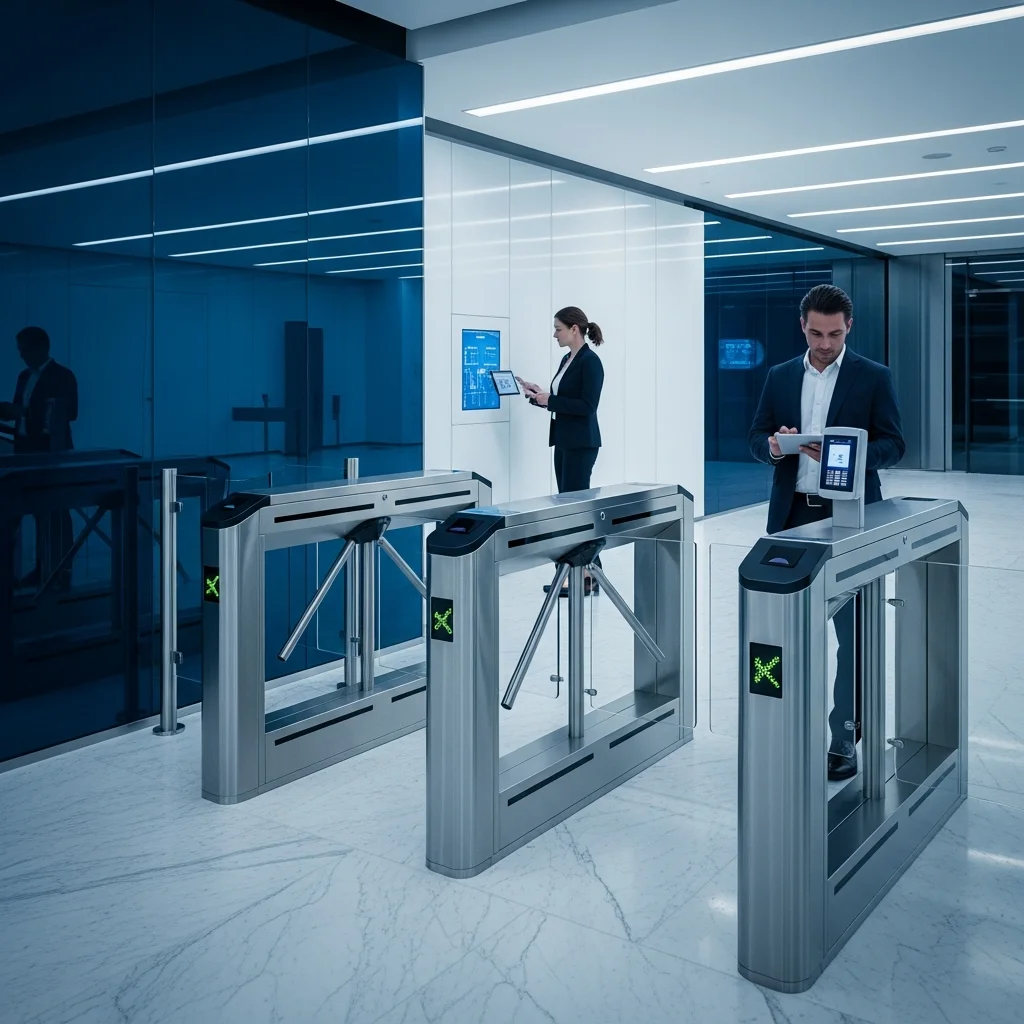
The technical design of an access control system has a direct impact on the works council's co-determination rights and on data protection requirements. There are various system types, each with different implications. Classic systems are often based on RFID cards or transponders that control access via readers. Biometric systems, which use fingerprints, iris scans or facial recognition, are technologically more advanced but also more sensitive from a data protection perspective, since they process particularly protection-worthy biometric data. PIN-based systems are less invasive but often offer a lower level of security. The choice of technology must therefore be carefully weighed up, not only in terms of security requirements but also with regard to data protection permissibility and acceptance by the works council.
A critical point is data collection and logging. Modern access control systems can store detailed logs of access attempts, successful entries, times and locations. These logging functions are often desirable for security reasons, since they enable traceability in the event of an incident. At the same time, however, they represent a potential monitoring capability that activates the works council's co-determination right under Section 87(1) No. 6 BetrVG. It must be clearly defined which data is collected for which purpose, how long it is retained, and who has access to it. Excessive data collection that is not justified by a legitimate purpose is not permitted.
The technical configuration must also offer the ability to limit data collection to the necessary minimum. For example, it can make sense to log access only to certain high-security areas, while access to general office areas merely registers presence without storing detailed movement data. The system architecture should also allow a clear separation of access rights, so that only authorised personnel can access the log data. PLANATEL® advises you on a manufacturer-independent basis in selecting and configuring the appropriate technology, to optimally meet both your security needs and the legal and co-determination requirements while avoiding unnecessary vendor dependency.
The process of involving the works council in planning
Successfully involving the works council in the planning of an access control system is a structured process comprising several phases. The first step is early notification. Before concrete technical decisions are made, the works council should be informed of the intention to introduce an access control system, the intended objectives (e.g. increasing security, simplifying administration) and the broad technical direction. This transparency builds a basis of trust and enables the works council to engage with the topic in good time.
This is followed by the consultation phase. Here, the details of the planned system, the technical possibilities, the potential effects on employees, and the data protection implications are discussed in detail. The company should make all necessary documents available to the works council, including technical specifications, data protection impact assessments (DPIAs) and drafts for data collection and processing. In this phase, external experts, such as PLANATEL® as an independent planner, can also be brought in to clarify technical questions and provide neutral assessments. The goal is to find joint solutions that do justice to both the company's interests and employees' rights.
The culmination of the process is the negotiation and conclusion of a works agreement. This written agreement is the central document that sets out the rights and obligations of both parties, as well as the precise framework for operating the access control system. It must regulate in detail which data is collected for which purpose, how long it is retained, who has access to it, what protective measures are taken, and what sanctions apply in the event of misuse. A well-negotiated works agreement creates legal certainty for the company and acceptance among employees. PLANATEL® supports you in preparing the technical foundations and drafting proposals that form a solid basis for negotiations with the works council.
Contents of a works agreement on access control
A comprehensive and legally compliant works agreement on access control is the foundation for smooth, accepted operation of the system. It must be worded precisely and unambiguously to avoid later conflicts. The essential contents include:
- Purpose definition: A clear statement of why the access control system is being introduced (e.g. protecting property, complying with security regulations, controlling visitor flows). The purpose must be legitimate and proportionate.
- Scope of application: A determination of which persons (employees, visitors, external service providers) and which areas (buildings, specific rooms, server rooms) are covered by the system.
- Technical description: A detailed description of the system used, the readers, the identification media (cards, biometrics) and the software.
- Data collection and processing: Precise information on which personal data (name, personnel number, access time, location) is collected and how it is processed and stored. Minimising data processing is decisive here.
- Retention and deletion periods: A clear determination of how long the collected data may be stored and when it must be automatically deleted. These periods must comply with data protection requirements and must not exceed what is necessary.
- Access rights: A definition of which persons or departments (e.g. security officer, HR department) have access to the collected data under which conditions. The four-eyes principle can be useful here.
- Data security: A description of the technical and organisational measures to protect the data against unauthorised access, loss or manipulation (e.g. encryption, access logs).
- Procedure in the event of misuse: Provisions for cases in which misuse of the system or the collected data is detected, including possible sanctions.
- Evaluation and adjustment: Agreements on regular reviews of the system and the works agreement, in order to respond to technical developments or changed legal frameworks.
- Training: A determination of training measures for employees and managers on how to use the system and the data protection provisions.
PLANATEL® supports you in preparing the technical specifications and drafting proposals for the works agreement that take all relevant aspects into account and form a solid basis for negotiations with the works council.
Challenges and solutions in practice
Planning and implementing works-council-compliant access control presents various challenges in practice that must be overcome. One of the most common difficulties is inadequate communication between company management and the works council. If the works council is informed too late or insufficiently, this can breed mistrust and complicate negotiations. Another stumbling block is unclear objectives on the part of the company. Without a precise definition of the purpose and the desired scope of functions of the system, it is difficult to find common ground for negotiations and to justify the proportionality of the measures.
The complexity of the technical and legal subject matter is also often a hurdle. Both the company side and the works council must develop a basic understanding of how the system works, the type of data collection, and the relevant data protection provisions. Misunderstandings or misinterpretations can quickly arise here. In addition, differing interests can lead to stalled negotiations. While the company may be striving for maximum security and efficiency, the works council focuses on comprehensive protection of employees' personality rights.
Proactive solutions are needed to overcome these challenges. Early and open communication is key. The company should involve the works council in the planning process from the outset and share all relevant information transparently. Defining clear and proportionate objectives for the access control system is likewise decisive. External, independent consulting, as offered by PLANATEL®, can serve as a bridge here. As a neutral party, we can present technical matters in an understandable way, objectively assess the data protection implications, and support the moderation of negotiations. Through our expertise, we help reconcile technical possibilities with legal necessities and develop a solution that works for all parties, one that both increases security and safeguards employees' rights.
Manufacturer independence and future-proof concepts
When planning access control systems, manufacturer independence is a decisive factor for long-term success and cost-effectiveness. Many companies tend to rely on the offerings of individual manufacturers, which can, however, often lead to unwanted vendor dependency. This manifests itself in limited flexibility for extensions or adjustments, potentially higher costs for maintenance and support, and more difficult integration with other systems. Independent planning, as PLANATEL® has offered since 1992, ensures that the selection of components and systems is based exclusively on the company's actual needs and technical requirements, not on the sales interests of a particular vendor.
A manufacturer-independent concept makes it possible to select the best solutions from the entire market. This can include combining components from different manufacturers to create an optimal system precisely tailored to the specific requirements. It also promotes competition in the tender and award process, which as a rule leads to better terms and higher implementation quality. PLANATEL® prepares detailed specifications of services and accompanies the tender process, to ensure that you receive offers that are comparable and meet your requirements.
In addition, the future-proofing of an access control system is of great importance. Technological developments are advancing rapidly, and the legal framework can also change. A future-proof concept accounts for this dynamic by relying on open standards, favouring modular architectures, and enabling scalability. This means that the system can be expanded, adapted or integrated with new technologies as needed, without requiring a complete replacement. PLANATEL® develops concepts that not only meet current requirements but also anticipate future developments and give you long-term investment security. We help you build a solid technical foundation that stands the test of time and gives you maximum flexibility.
The role of PLANATEL® in the legally compliant planning of access control systems
PLANATEL® sees itself as your independent partner for the legally compliant and efficient planning of access control systems. With more than 34 years of experience in consulting and planning complex infrastructure projects, we offer comprehensive expertise that goes far beyond pure technology. Our services are designed to guide you through the entire process, from the initial needs analysis to the successful acceptance of the system, always taking into account the specific requirements for works-council-compliant implementation.
Our approach begins with a detailed as-is survey and needs analysis. We analyse your existing structures, security requirements and the specific circumstances of your company. Building on this, we develop a target concept that takes into account not only technical aspects but also the legal framework, in particular the works council's co-determination right and data protection requirements, integrated from the outset. We prepare a data protection impact assessment and develop proposals for the works agreement that serve as the basis for negotiations with the works council.
A central part of our service is manufacturer-independent planning and tendering. We prepare detailed specifications of services that enable transparent, comparable bidding. This not only secures your selection of the technically and economically best solution, but also avoids unnecessary vendor dependency. During the implementation phase we support you in selecting certified installers and monitor implementation to ensure that the planning is followed exactly. We are also on hand for acceptance and invoice review, to safeguard the quality of the work and ensure cost control.
Working with PLANATEL®, you benefit from independent expertise that helps you minimise legal risks, foster employee acceptance, and implement a future-proof access control system that is optimally tailored to your needs. We are your reliable advisor, helping you deliver complex projects efficiently and in a legally compliant way.

Next step
Contact us for a no-obligation initial consultation.
PLANATEL®: Independent planning and consulting since 1992
Tel: 040 / 23 73 02-30
E-Mail: info@planatel.de
Frequently asked questions
Why is early involvement of the works council so important for access control?
Early involvement of the works council is decisive for preserving its co-determination rights under the BetrVG and avoiding legal conflicts. It makes it possible to address employees' concerns early on and builds trust and acceptance for the new system. In addition, the works council's valuable perspectives can flow into the planning, leading to an optimised, more practicable solution that does justice to both the company's security interests and employees' personality rights.
What role does the data protection impact assessment (DPIA) play in planning access control?
The data protection impact assessment (DPIA) is a mandatory instrument under the GDPR whenever the introduction of an access control system is likely to result in a high risk to the rights and freedoms of natural persons. It serves to identify potential data protection risks and define suitable measures to mitigate them. A careful DPIA is thus a central part of legally compliant planning and should be carried out in collaboration with the data protection officer and the works council.
What does manufacturer independence mean when planning access control systems?
Manufacturer independence means that the planning and selection of the components of an access control system take place independently of the interests of individual manufacturers. The aim is to find the objectively best technical and economic solution for the company, without committing to particular products or vendors. This prevents vendor dependency, promotes competition in the tender process, and secures long-term flexibility and cost efficiency. PLANATEL® offers this independent consulting.
Can an access control system also be used for time recording?
Yes, access control systems can technically be used for time recording, since they log attendance times. However, this is particularly sensitive from a data protection and co-determination perspective. Such use requires an explicit provision in the works agreement that clearly defines the purpose, the scope of data collection and the retention period. The data must be limited to what is absolutely necessary, and employees' personality rights must be comprehensively protected.
How can PLANATEL® support companies in works-council-compliant planning?
PLANATEL® comprehensively supports companies in the works-council-compliant planning of access control systems. We offer an independent needs analysis, develop manufacturer-independent target concepts, and prepare detailed specifications of services for the tender. We also advise on preparing data protection impact assessments and develop drafts for works agreements that serve as the basis for negotiations with the works council. Our expertise secures a legally compliant, efficient and future-proof solution.
Which laws govern the works council's co-determination on access control?
In Germany, the Works Constitution Act (BetrVG) primarily governs the works council's co-determination on technical devices intended to monitor employee behaviour or performance, in particular Section 87(1) No. 6. In addition, the GDPR and the Federal Data Protection Act (BDSG) are relevant, since access control systems process personal data.
What happens if the works council does not consent to access control?
If the works council does not consent to the introduction of an access control system, the company cannot simply implement the system. Legal disputes before the labour court threaten, which can lead to a court-ordered ban on use. In addition, violations of data protection regulations can result in high fines.
What data may access control systems collect?
Access control systems may only collect data that is absolutely necessary for the defined purpose (e.g. security, access authorisation). This can include names, personnel numbers, and access times and locations. Excessive data collection that is not justified by a legitimate purpose is not permitted and violates the principles of data minimisation and purpose limitation under the GDPR.
How long may access data be stored?
The retention period for access data must be clearly set out in the works agreement and limited to what is absolutely necessary. It must comply with data protection requirements, which only permit storage for as long as is necessary for the original purpose. Once this period has expired, the data must be automatically deleted.