


Fire Alarm Systems16 min read
Fire Alarm System HOAI Planning: Independent Expertise for Your Security
Planning fire alarm systems is a complex task that requires extensive technical and legal knowledge. Sound planning based on HOAI principles secures not only functionality, but also the long-term cost-effectiveness and legal compliance of your systems.
Planning fire alarm systems according to the HOAI structure involves the detailed division of planning services into nine service phases, from establishing the basis of the project through to acceptance and invoice review. Although the HOAI has no longer been binding since 2021, it continues to serve as an authoritative point of reference for transparent, quality-assured fee determination and service descriptions in the field of technical building services, particularly for fire alarm systems.
Structured, legally compliant planning of fire alarm systems according to HOAI service phases
Planning fire alarm systems is a complex task that requires extensive technical and legal knowledge. Sound planning based on HOAI principles secures not only functionality, but also the long-term cost-effectiveness and legal compliance of your systems.
Key Takeaways
- Planning fire alarm systems according to the HOAI structure ensures transparency and quality, even though the HOAI has served merely as a point of reference since 2021.
- Manufacturer-independent planning is essential to avoid cost traps, planning errors and dependence on a single manufacturer, and to find the optimal solution.
- Compliance with standards such as DIN 14675, VdS 2095 and DIN VDE 0833 is essential for the legal compliance and insurance cover of your fire alarm system.
The early detection and reporting of fires is of critical importance for protecting human life, assets and business continuity. Fire alarm systems are the heart of this system-based protection. Planning them, however, is a highly complex discipline that requires not only in-depth technical understanding but also comprehensive knowledge of the relevant standards and guidelines. In Germany in particular, the Fee Structure for Architects and Engineers (HOAI) serves as an important point of reference for structuring and remunerating these planning services. Faulty or inadequate planning can have serious consequences, ranging from legal repercussions to existence-threatening damage in the event of a fire. Independent, experienced planning is therefore essential to ensure maximum safety and long-term cost-effectiveness.

The Fundamental Importance of Professional Fire Alarm System Planning
Fire alarm systems are far more than mere technical installations; they save lives and protect assets. Their correct function in an emergency depends largely on careful, forward-looking planning. Professional planning takes into account not only the specific circumstances of a building or facility, but also integrates all relevant legal requirements and technical standards. This begins with a precise needs analysis and extends to determining the optimal placement of detectors and the alarm strategy. Without such a sound basis, there is a risk of false alarms, inadequate fire detection or even system failure at the critical moment. Such shortcomings can not only lead to considerable financial losses through property damage, but also endanger the safety of people and give rise to far-reaching legal liability issues for operators and those responsible. Investing in high-quality planning is therefore an investment in the safety and future viability of a company.
The complexity of modern buildings and the diversity of usage scenarios call for a tailored approach. A standard approach is rarely sufficient here. Instead, a detailed analysis of fire risk, structural conditions, existing infrastructure and specific protection objectives is required. Only in this way can a fire detection concept be developed that is optimally tailored to individual requirements while also offering the possibility of integration into existing or future building management systems. This requires a planning service that goes beyond pure technical design and encompasses strategic aspects of building security and operations management.
Legally Compliant Foundations of Fire Alarm System Planning: Standards and Guidelines
The planning, installation and operation of fire alarm systems in Germany are subject to a complex web of legal requirements and technical standards. These sets of rules are crucial for ensuring the operational reliability and legal compliance of the systems. The most important standards include DIN 14675, which describes the entire life cycle of a fire alarm system from project planning through to servicing, and DIN VDE 0833-2, which sets out detailed requirements for fire detection and alarm systems. In addition, the European product standards in the EN 54 series must be observed, which define the requirements for the individual components of the fire alarm system.
In addition, the VdS guidelines, particularly VdS 2095 ("Automatic Fire Alarm Systems, Planning and Installation"), play an important role. These guidelines give concrete form to the requirements of DIN VDE 0833-2 and are often explicitly required by property insurers or clients in order to ensure a VdS-approved fire alarm system. Compliance with these standards and guidelines is not only a matter of technical quality but also of legal protection. Non-compliance risks not only the loss of insurance cover but also considerable liability risks in the event of fire. Independent planning ensures that all relevant regulations are correctly interpreted and implemented from the outset, minimising the risk of rework and legal disputes.
The fire detection concept under DIN 14675 is a key component of optimal, legally compliant planning. It is drawn up in close coordination with the authorities, the fire brigade, insurers and specialist planners, and sets out the protection objectives, protection categories, monitoring zones and alarm organisation. Responsibility for producing this concept lies with the client, who may however commission a specialist firm to do so. Independent planning ensures that this concept is drawn up objectively and in the client's best interest, free of the potential conflicts of interest that could arise with manufacturer-affiliated planners.
The HOAI as a Point of Reference for Planning Technical Building Services
The Fee Structure for Architects and Engineers (HOAI) serves in Germany as the central point of reference for the remuneration of planning services. Although the HOAI has no longer prescribed binding minimum and maximum fees since the 2019 ruling of the European Court of Justice and the 2021 amendment, it retains its significance as a structuring and qualitative reference framework. It provides a transparent basis for fee agreements and divides the services into nine successive service phases that map out the entire planning and construction process. Part 4 of the HOAI, Technical Building Services, is particularly relevant for planning fire alarm systems, specifically Section 56 HOAI.
The HOAI helps clearly define the scope and quality of planning services and creates a comprehensible basis for fee calculation. This is particularly important for complex projects such as planning fire alarm systems, where requirements can vary considerably. The fee zones under Section 56 HOAI (Fee Zone I for low, Fee Zone II for average and Fee Zone III for high requirements) allow for a differentiated assessment of the degree of planning difficulty. Criteria for assigning a fee zone include the number of functional areas, integration requirements, technical design and the demands placed on the technology. A fire alarm system with several sub-panels and a large number of diverse components, for example, can represent a high planning requirement and therefore be assigned to a higher fee zone.
For clients, orienting themselves by the HOAI offers important reassurance: it enables a transparent comparison of bids and protects against unrealistically low or excessive fee demands. At the same time, it promotes quality-oriented planning, as the service phases describe in detail which basic services are required for proper project execution. PLANATEL® uses the HOAI structure to offer its clients a clear, comprehensible description of services and fee structure, based on more than 34 years of experience and in-depth expertise.
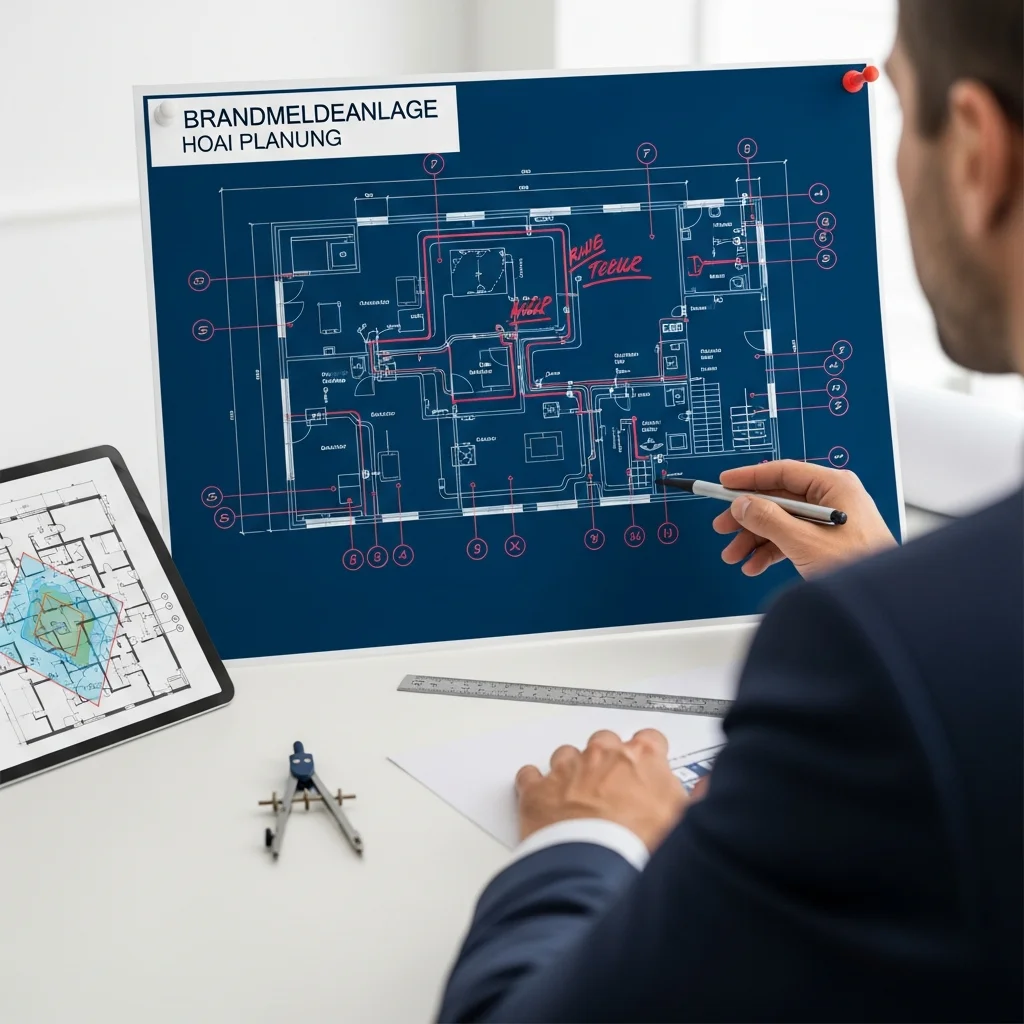
Service Phases of Fire Alarm System Planning under the HOAI Structure: A Detailed Overview
The HOAI divides the planning services for technical building services, which include fire alarm systems, into nine service phases (LPH). These phases form a logical, successive process that extends from the initial idea through to final acceptance and invoice review. The first five phases in particular are of central importance for fire alarm system planning, as they lay the foundation for subsequent realisation.
- LPH 1: Basic evaluation (2% of the fee): In this phase, the brief is clarified, feasibility is assessed and the framework conditions are analysed. For fire alarm systems, this means recording the building's use, its structural conditions, potential fire hazards and the protection objectives. This is where the groundwork for the fire detection concept is laid.
- LPH 2: Preliminary design (9% of the fee): Based on the basic evaluation, initial concepts are developed, system dimensions are determined and cost-effectiveness assessments are carried out. For fire alarm systems, the basic system architecture, the type of detector and the alarm strategy are provisionally defined here.
- LPH 3: Design planning (17% of the fee): The planning concept is worked through and a functional, technical solution is developed. This includes preparing the detailed fire detection concept, defining the detector zones and integrating it into the overall building concept.
- LPH 4: Approval planning (2% of the fee): All documents required for regulatory approval are prepared and submitted. For fire alarm systems, this in particular involves coordination with the fire brigade and building supervisory authorities, as well as the preparation of fire brigade plans and run cards.
- LPH 5: Execution planning (22% of the fee): The design and approval planning is translated into construction-ready planning documents. This produces detailed installation and wiring diagrams, cable routes and the precise placement of all components. Precise execution planning is crucial for a smooth, error-free installation.
The remaining phases (preparation for the award of contract, assistance with awarding, site supervision, acceptance and invoice review) are equally important, but relate more to implementation and operation, where PLANATEL® acts in an advisory capacity and accompanies the selection of certified installers. The detailed handling of each of these phases by an independent planner such as PLANATEL® minimises risk and ensures that the fire alarm system meets the highest quality and safety standards.
Challenges and Risks in Fire Alarm System Planning without Independent Expertise
Planning fire alarm systems is a field that carries considerable risk without independent expertise. One of the biggest challenges is the potential for dependence on a manufacturer. If the planning is carried out by an installer or planner who is tied to particular manufacturers or receives commissions, there is a risk that the solution chosen will not be the objectively best one, but the one most lucrative for the planner. This can lead to oversized installations, unnecessarily complex systems, or the use of components that are not optimally tailored to the specific needs of the property. Such decisions often result in higher acquisition and operating costs, as well as limited flexibility for future expansions or adjustments.
Another risk is planning errors arising from insufficient or outdated expertise. The standards landscape for fire alarm systems is dynamic and complex. Inadequate consideration of current DIN standards (e.g. DIN 14675, DIN VDE 0833) or VdS guidelines can mean that the system fails to deliver the expected performance in an emergency, or is not even approvable. This not only results in costly rework, but can also jeopardise insurance cover and, in the worst case, lead to criminal consequences for those responsible.
In addition, cost traps can arise if planning is not carried out transparently and in detail. Unclear service descriptions, missing specifications or the absence of independent cost control can lead to the project budget being significantly exceeded. Without clear structuring according to the HOAI service phases and an independent review of installers' bids, it is difficult for clients to assess the actual costs and scope of services. Independent planning by PLANATEL® eliminates these risks by creating an objective, manufacturer-independent, legally compliant basis for your fire alarm system project.
The Added Value of Independent Planning: Manufacturer Independence and More Than 34 Years of Experience
In the complex world of fire alarm system planning, independence is a decisive factor for project success. Since 1992, PLANATEL® has stood for 100% manufacturer independence and financial independence. This means that our recommendations and planning are based solely on the objective requirements of your project and are not influenced by manufacturer interests or commissions. We receive no remuneration whatsoever from manufacturers or installers, which ensures transparent, trustworthy advice. This independence is the cornerstone on which we have operated successfully for more than 34 years, offering our clients tailored, future-proof solutions.
Our more than 34 years of experience planning complex infrastructure projects, including fire alarm systems, puts us in a position to master even the most demanding challenges. We know the intricacies of the relevant standards such as DIN 14675, VdS 2095 and DIN VDE 0833 from practical experience, and know how to apply them optimally to the specific circumstances of your property. This deep expertise enables us to identify potential problems early, minimise risk and develop innovative solutions that are both technically mature and economical.
The added value of our independent planning is evident in several respects: you receive an objective assessment of the best technologies and systems on the market, an optimised cost structure through the avoidance of unnecessary components, and greater investment security. We act as your competent partner, representing your interests and ensuring that the planned fire alarm system not only meets current requirements but is also flexible enough to accommodate future developments. With PLANATEL®, you choose planning based on trust, expertise and uncompromising independence.
From Concept to Legally Compliant Realisation: The PLANATEL® Approach
The PLANATEL® approach to planning fire alarm systems is a structured process that covers all necessary steps from the initial idea through to preparation for realisation. We always begin with a comprehensive basic evaluation and needs analysis. In this phase, we work with you to clarify the specific protection objectives, analyse the structural and operational circumstances of your property, and identify potential fire hazards. This forms the basis for a tailored fire detection concept that takes into account all relevant standards and guidelines, such as DIN 14675 and VdS 2095.
This is followed by preliminary and design planning, in which we develop detailed system architectures, select components and plan integration into existing infrastructure. Our manufacturer-independent approach guarantees that we always identify the technically and economically optimal solutions for your project. We prepare precise specifications of services and specifications that form a clear basis for the subsequent tender and award. This minimises the risk of misunderstandings and supplementary claims during the implementation phase.
A further decisive step is support in selecting certified installers. As a planning and consulting company, we do not carry out installations or maintenance ourselves. Instead, we support you in tendering the planned fire alarm system and evaluating the bids. We select only certified specialist firms that are qualified to DIN 14675 and VdS 2095 and have the necessary expertise for proper installation and commissioning. Through this independent selection process, we ensure that the realisation of your fire alarm system meets the highest quality standards and that the planned functionality is fully achieved. Our goal is to enable you to have a legally compliant, efficient, future-proof fire alarm system that is optimally tailored to your needs.

Next Step
Contact us for a no-obligation initial consultation.
PLANATEL®: Independent planning and consulting since 1992
Tel: 040 / 23 73 02-30
Email: info@planatel.de
Frequently Asked Questions
What is meant by the fire detection concept under DIN 14675?
The fire detection concept under DIN 14675 is a central document for planning a fire alarm system. In close coordination with the authorities, the fire brigade and insurers, it sets out the protection objectives, the type and scope of monitoring, the alarm organisation and the necessary fire-event control functions. It forms the binding basis for all further planning and realisation steps and is decisive for the legal compliance of the system. Responsibility for producing it lies with the client, who may commission a specialist firm to do so.
How does the HOAI affect fees for fire alarm system planning following the 2021 amendment?
Since the 2021 HOAI amendment, the minimum and maximum fee rates are no longer binding. However, the HOAI continues to serve as an authoritative point of reference for determining fees. The fee tables and service profiles remain in place and offer a transparent structure for agreeing appropriate fees. If no written agreement is reached, the basic fee rate is deemed to apply. This continues to promote quality-oriented planning and protects against ruinous price competition.
What risks arise from non-compliant fire alarm system planning?
Non-compliant planning of fire alarm systems carries significant risks. These include the loss of insurance cover in the event of fire, which can lead to massive financial losses. There is also the threat of legal consequences for operators and those responsible, up to and including criminal liability in the event of personal injury. Regulatory conditions, fines and the need for costly rework are further consequences. A faulty system also endangers human life and business continuity.
What does manufacturer independence mean in fire alarm system planning?
Manufacturer independence in fire alarm system planning means that the planner has no financial or contractual ties to particular manufacturers of fire alarm systems. Systems and components are selected exclusively on the basis of objective criteria such as technical suitability, cost-effectiveness, scalability and the specific requirements of the project. This ensures that the best solution is found for the customer, free of the conflicts of interest that could arise with manufacturer-affiliated planners. PLANATEL® has been 100% manufacturer-independent since 1992.
How does PLANATEL® support the realisation of the planned fire alarm system?
PLANATEL® is a planning and consulting company and does not carry out installations or maintenance itself. However, we provide comprehensive support to our customers in realising the planned fire alarm system, advising you on the selection of certified installation companies. We ensure that the selected specialist firms hold the necessary qualifications under DIN 14675 and VdS 2095, to guarantee proper installation and commissioning in line with the detailed planning.
What role does the HOAI play in planning fire alarm systems?
The HOAI serves as a point of reference for fee calculation and service description when planning fire alarm systems as part of technical building services. It divides the planning services into nine phases and helps to define the scope and quality of the services transparently, even though its fee rates have no longer been binding since 2021.
Which standards are relevant for planning fire alarm systems?
The standards primarily relevant to planning fire alarm systems are DIN 14675 (life cycle of fire alarm systems), DIN VDE 0833-2 (fire detection and alarm systems) and the European EN 54 series (components). The VdS 2095 guidelines (planning and installation) are also often decisive, particularly where VdS approval is required.
Why is independent planning of fire alarm systems important?
Independent planning of fire alarm systems is crucial for avoiding dependence on a manufacturer, planning errors and unnecessary costs. It ensures that the selection of systems and components is made objectively and in the client's best interest, based on the actual requirements and the optimal technical solution.
What are the main phases of fire alarm system planning under the HOAI?
The main phases of fire alarm system planning under the HOAI comprise basic evaluation (LPH 1), preliminary design (LPH 2), design planning (LPH 3), approval planning (LPH 4) and execution planning (LPH 5). These phases cover the entire conception and detailing of the fire alarm system before realisation begins.
Sources and Further Information
- brandschutzdozenten.de
- heinrich-brandmeldetechnik.de
- ki365.net
- graef-brandmeldesysteme.de
- vde-verlag.de