


Fire Alarm Systems18 min read
The Operational-Principle Test to DIN 14675: Fundamental Safety for Fire Alarm Systems
In modern building structures, the smooth interaction of all security-technology systems in the event of fire is decisive. The operational-principle test to DIN 14675 ensures that your fire alarm systems and the control systems connected to them act reliably in an emergency. Find out how this test maximises operational safety and meets legal requirements.
The operational-principle test to DIN 14675 is a cross-trade test that checks the intended interaction of fire alarm systems (BMA) with other security-technology installations in the event of a hazard. It is required under building law, particularly for special-purpose buildings, and must be carried out before commissioning, after significant changes, and at recurring intervals, in order to guarantee the functionality and legal compliance of the entire safety chain.
Ensuring the fault-free interaction of security-technology systems in complex buildings
In modern building structures, the smooth interaction of all security-technology systems in the event of fire is decisive. The operational-principle test to DIN 14675 ensures that your fire alarm systems and the control systems connected to them act reliably in an emergency. Find out how this test maximises operational safety and meets legal requirements.
Key Takeaways
- The operational-principle test to DIN 14675 is decisive for the operational safety of fire alarm systems and the coordinated interaction with other security-technology systems in buildings.
- Manufacturer-independent planning by independent experts such as PLANATEL® minimises manufacturer dependencies, optimises costs, and creates the best foundation for a successful and efficient operational-principle test.
- Regular operational-principle tests are not only an obligation under building law, but a strategic investment in risk minimisation, legal compliance, and the long-term economic efficiency of your properties.
The complexity of modern buildings demands a high degree of integration and coordination of all technical systems. In the field of fire alarm systems (BMA) in particular, it is critically important that, in an emergency, not only the individual components function, but the entire system network works together smoothly. This is where the operational-principle test to DIN 14675 comes in. It is far more than a pure functional check; it is the comprehensive verification of the interaction of the BMA with other security-technology systems and installations. For operators of medium and large enterprises, public institutions, and property managers, this test represents a central pillar of risk minimisation and of ensuring legal compliance. Sound planning and careful execution are essential to effectively achieve the protection objectives and guarantee long-term operational safety.

Fundamentals and necessity of the operational-principle test to DIN 14675
The operational-principle test (WPP) is an essential component of quality assurance and operational safety for fire alarm systems in complex buildings. It goes beyond the pure testing of individual components and focuses on the intended interaction of all security-technology systems in the event of fire. This covers the interaction of the fire alarm system with systems such as smoke and heat extraction systems (RWA), safety lighting, lift controls, door-holding systems, and other technical installations that require a coordinated response in an emergency. The Model Testing Ordinance (MPrüfVO) and the state building codes based on it anchor the WPP as a requirement under building law, particularly for special-purpose buildings such as hospitals, assembly venues, industrial facilities, or office buildings.
Without such a cross-trade test, there is a risk that, despite flawless individual functions, the overall safety chain fails in an emergency. A smoke detector may trigger correctly, but if the activation of the RWA system or the release of the escape routes does not work, the protection of people and assets is inadequate. The WPP is thus the decisive instrument for validating these critical interfaces and identifying potential sources of error in the interaction of the systems at an early stage. It is carried out before initial commissioning, after significant changes, and at recurring intervals, generally every three years, by testing experts recognised under building law.
For operators, the operational-principle test means not only meeting statutory obligations, but also a significant reduction in operational risk and an increase in investment security. A well-planned and regularly tested fire alarm system, whose interaction with other systems has been demonstrated, minimises the extent of damage in the event of fire and protects human life. PLANATEL® supports you as an independent planner in laying the foundations for a successful operational-principle test already during the concept and planning phase.
Legal and normative framework: DIN 14675, DIN VDE 0833, and VdS 2095
The operational-principle test is deeply anchored in a network of standards and guidelines that govern the structure and operation of fire alarm systems. The central German standard for this is DIN 14675, which describes the proper structure and operation of fire alarm and voice alarm systems (SAA). It divides the life cycle of a BMA into various phases, from concept development through planning and detailed engineering to installation, commissioning, and servicing. In particular for planning (phase 6.1) and detailed engineering (phase 6.2), DIN 14675 sets out detailed requirements for the professional competence of the companies involved.
In addition to DIN 14675, the standard series DIN VDE 0833 is significant, particularly Part 2: "Requirements for fire alarm systems". This standard defines technical requirements for hazard detection systems for fire, intrusion, and hold-up, and was published in a new edition in June 2022. It contains important provisions for electrical engineering in building law and is decisive for the technical design of the BMA. The European standard series EN 54, in turn, sets product standards and application guidelines for components of fire alarm systems, such as detectors, control panels, and alarm devices, and has been adopted in Germany as DIN EN 54.
In addition to these standards, the VdS guidelines, in particular VdS 2095 "Guidelines for automatic fire alarm systems, planning and installation", also play an important role. Although VdS guidelines are not statutory requirements, in practice they are frequently explicitly required by property insurers or clients, and they concretise the requirements of DIN 14675 and DIN VDE 0833 with insurance-related aspects. Compliance with these bodies of rules is decisive not only for legal compliance, but also for recognition by insurers and for guaranteeing a high safety standard. PLANATEL® always takes all relevant standards and guidelines into account in its manufacturer-independent planning, to guarantee a future-proof and legally compliant solution.
The detailed course of an operational-principle test
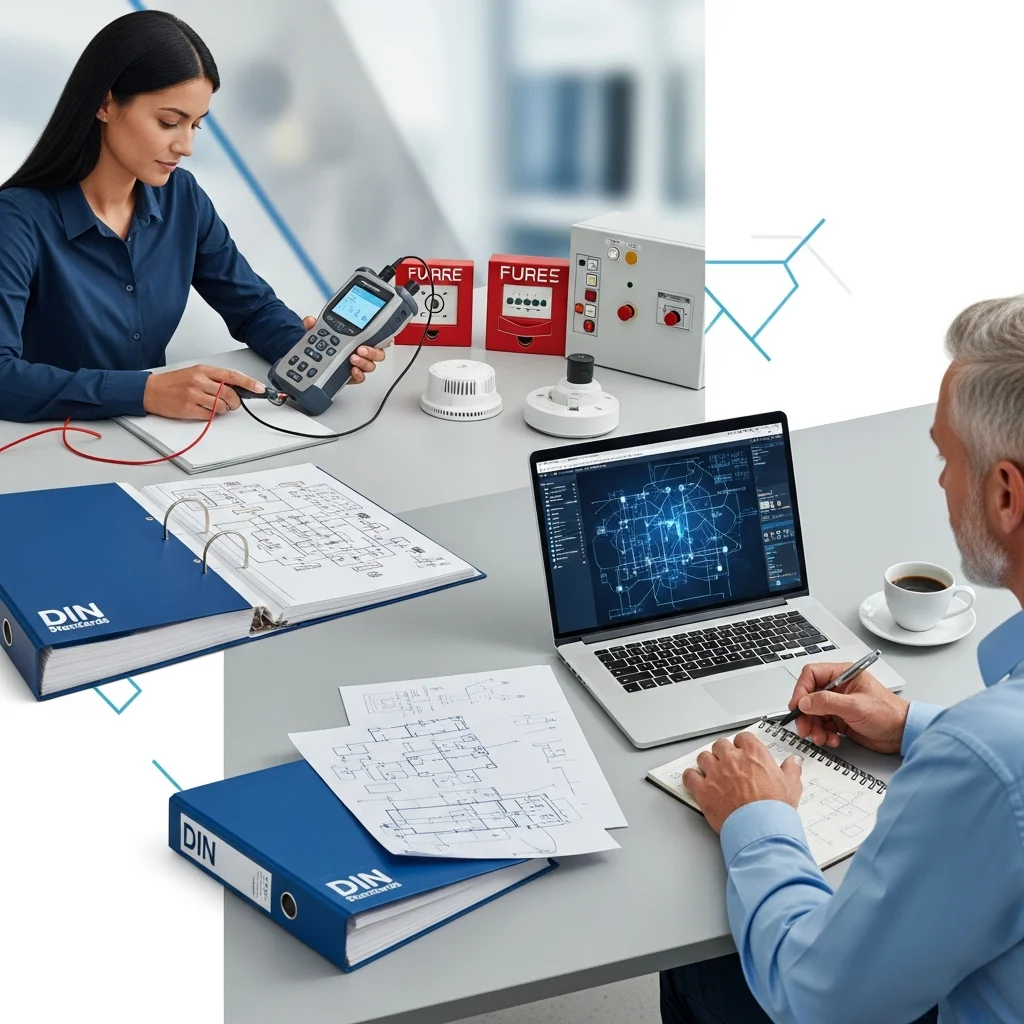
Carrying out an operational-principle test is a complex process that requires careful preparation and coordination. The course of the test is typically divided into several phases that systematically verify the interaction of the fire alarm system with all relevant security-technology installations. First, a comprehensive visual inspection and documentation of the existing systems and their interfaces takes place. Here, the fire-event control matrix, the alarm organisation, and all relevant planning documents prepared by PLANATEL® are used as the basis.
At the core of the test is the triggering of defined scenarios. This means that fire alerts are simulated in order to observe the responses of the fire alarm system and the systems it activates. For example, it is checked whether, in the event of a fire alert in a specific area, the smoke and heat extraction system opens correctly, the lifts move to the evacuation position, door-holding systems are released, safety lighting switches on, and the voice alarm system plays the correct announcements. Scenarios such as a power failure in the event of fire and the restart of security-technology installations are also taken into account.
During these tests, the interfaces and freedom from feedback effects of the systems are examined in the closest detail. It is documented whether all alerts are transmitted reliably and whether the actuators activated perform the desired function. Frequently, several specialist companies from the trades involved need to be brought in to support the checking of the complex control sequences. The results of the test are documented in detail, including identified defects and recommendations for remedy. This documentation is decisive for proving legal compliance and for the continuous improvement of system safety. PLANATEL® accompanies you through this process, from preparing the fire-event matrix to coordinating the tests, to guarantee a smooth course.
The importance of manufacturer-independent planning for a successful operational-principle test
Manufacturer-independent planning of fire alarm systems is a decisive factor for the long-term success and economic efficiency of an operational-principle test. As an independent planning and consulting company, PLANATEL® has operated fully manufacturer-independently and financially independently since 1992. This means that our recommendations and planning serve exclusively the interests of our clients and are not influenced by commissions or partnerships with particular manufacturers. This independence is especially valuable, as it enables an objective selection of the best technical solutions, optimally tailored to the specific requirements of the building and the operator.
When planning a fire alarm system and the associated interfaces to other systems, it is decisive not to be tied to the products or systems of a single manufacturer. Manufacturer-dependent planning can lead to suboptimal solutions, unnecessary costs, and more difficult integration with existing or future systems. This can in turn have a negative effect on the complexity and the costs of the operational-principle test, since the compatibility and interaction of different components may not be optimally guaranteed. PLANATEL®'s manufacturer-independent approach ensures that the planned system meets the highest standards of functionality, reliability, and future-proofing, without creating unnecessary manufacturer dependencies.
By selecting components and systems that meet the requirements of DIN 14675, DIN VDE 0833, and VdS 2095, but are not tied to a specific provider, we create a flexible and expandable infrastructure. This not only facilitates later maintenance and servicing, since you are not reliant on a single service provider, but also optimises the conditions for a successful and efficient operational-principle test. Our more than 34 years of experience in independent planning guarantee that all aspects of the operational-principle test are already taken into account during the concept phase, to avoid later surprises or costly rework.
Common challenges and sources of error in the operational-principle test
Despite the clear normative requirements and the high relevance of the operational-principle test, challenges and sources of error that can jeopardise the success of the test repeatedly arise in practice. One of the most frequent difficulties lies in insufficient coordination between the trades involved. Fire alarm systems interact with a large number of other systems, which are often installed and serviced by different specialist companies. Missing agreements, unclear interface descriptions, or communication problems between fitters and technicians can mean that the interaction of the systems does not work as intended in an emergency.
Another critical point is inadequate or outdated documentation. A precise and up-to-date fire-event control matrix, as well as detailed circuit diagrams and functional descriptions, are the basis for a successful test. If these documents are missing or are faulty, the systematic verification of the operational principles is made considerably more difficult, or impossible. This can lead to significant delays and additional costs, since the actual functioning of the system first has to be determined through considerable effort. Changes to the building structure or its use that were not tracked in the documentation are also a frequent source of error.
In addition, technical defects at the interfaces or in the programming of the controls can occur. Even when a signal is sent correctly by the fire alarm system, it is not always guaranteed that the receiving system interprets it correctly and performs the desired action. Such errors can often only be uncovered as part of a cross-trade operational-principle test. Defect statistics for effectiveness and operational-safety tests, including the operational-principle test, show that defects, from minor to significant, are common. Significant defects directly impair the safety function. PLANATEL® helps you avoid these pitfalls through precise planning and comprehensive support, to ensure a smooth operational-principle test.
Long-term benefits and economic efficiency through professional operational-principle testing
The operational-principle test is far more than a statutory obligation; it is a strategic investment in the long-term safety and economic efficiency of your properties and operational processes. A key benefit lies in sustainable risk minimisation. Through the systematic verification of the interaction of all security-technology systems, the probability of a system failure in the event of fire is drastically reduced. This protects not only human life and assets, but also the continuity of your business processes. A fire event can lead to significant business interruptions, the costs of which often exceed the direct property damage many times over. A functioning fire alarm system, whose operational principles have been tested, minimises this risk.
In addition, a professionally conducted operational-principle test contributes to the optimisation of operating costs. Errors and defects uncovered during the test can be remedied at an early stage, before they lead to greater damage or costly emergency repairs. A well-documented and regularly tested system can also have a positive effect on your insurance premiums, since it represents a lower risk for the insurer. The investment in careful planning and testing thus pays for itself through avoided damage, reduced downtime, and potentially more favourable insurance terms.
Another aspect is ensuring legal compliance. Complying with the testing obligations under DIN 14675 and the respective state building codes protects you from legal consequences and liability risks. In the event of a fire, proof of a properly conducted operational-principle test can be of decisive importance. PLANATEL® supports you in fully exploiting these benefits. Our independent planning creates the conditions for an efficient and successful test that not only meets the statutory requirements, but also offers real added value for the safety and economic efficiency of your infrastructure. With more than 34 years of experience, we know how to create long-term value and minimise risk.
The role of PLANATEL®: independent planning for a successful operational-principle test
As an independent planning and consulting company, PLANATEL® plays a central role in ensuring a successful operational-principle test for your fire alarm systems. Our expertise comes into play already in the early phases of the project, long before the actual test takes place. We begin with the preparation of a sound fire alarm concept (phase 5 to DIN 14675), which sets out the protection objectives, the monitoring scope, and the necessary control functions in detail. This concept forms the indispensable foundation for the subsequent planning and detailed engineering of the BMA and the interfaces to other systems.
In the planning phase (phase 6.1 to DIN 14675), we develop the optimal system architecture on a manufacturer-independent basis, select suitable components, and precisely define the interfaces to all relevant security-technology systems. This includes preparing a detailed fire-event control matrix that maps the exact interaction of the systems in the event of fire. Our many years of experience (since 1992, so more than 34 years) enable us to identify and eliminate potential conflicts or weaknesses in the system integration already on paper. We ensure that all planning documents comply with current standards such as DIN 14675, DIN VDE 0833, and VdS 2095, and form a clear basis for later installation and testing.
We plan maintenance concepts and support you in the selection of certified installers for the assembly and commissioning of the systems. Our support also extends to the preparation and coordination of the operational-principle test. We act as the link between you, the installers of the various trades, and the testing experts, to guarantee a smooth and efficient testing process. Through our independent and competent consulting, we ensure that your fire alarm systems not only meet the statutory requirements, but also offer the highest degree of safety and reliability, which is reflected in a successful and efficient operational-principle test.
Future developments and the continuing importance of the operational-principle test
The world of building technology and security systems is subject to constant change. New technologies, such as intelligent sensors, networked building management systems, and advanced communication solutions, are being introduced and are increasing the complexity of the systems. These developments place new demands on the planning, installation, and, in particular, the testing of fire alarm systems and their interaction with other systems. In this context, the operational-principle test will not only retain its high importance, but is likely to gain further significance, as the fault-free interaction of increasingly complex systems becomes more critical.
The integration of artificial intelligence and machine learning into fire alarm systems promises even more precise and faster fire detection, as well as optimised control of emergency measures. At the same time, this greater intelligence also requires an even more thorough review of the algorithms and interaction logic as part of the operational-principle test. Standards and guidelines, such as DIN 14675 and DIN VDE 0833, are being continuously developed further to take account of these technological advances and to adapt the requirements for professional competence and testing procedures.
For operators, this means that forward-looking and future-oriented planning of fire alarm systems is essential. PLANATEL® follows these developments closely and integrates the latest findings and best practices into its planning and consulting services. We help you design your fire alarm systems so that they meet not only today's but also future requirements, and so that a successful operational-principle test is guaranteed even as system complexity increases. PLANATEL®'s independent expertise is your guarantee that your investments in security technology remain valuable in the long term, and that the functionality of your systems is always secured at the highest level.
Next step
Contact us for a non-binding initial consultation.
PLANATEL®: Independent planning and consulting since 1992
Tel: 040 / 23 73 02-30
Email: info@planatel.de
Frequently asked questions
Why is the operational-principle test so important for operators?
The operational-principle test is of decisive importance for operators, as it guarantees the functional safety and the smooth interaction of all security-technology systems in the event of fire. It minimises the risk of personal injury and loss of assets, secures the continuation of operations, and ensures legal compliance under building law and relevant standards such as DIN 14675. A successful test protects against liability risks and can have a positive effect on insurance premiums, by confirming the reliability of the fire alarm systems and the entire safety chain.
What role does the fire-event control matrix play in the operational-principle test?
The fire-event control matrix is the central basis for the operational-principle test. It documents in detail which responses and control functions are to be triggered by which security-technology systems in the event of a fire alert in a specific area. During the operational-principle test, the scenarios defined in the matrix are simulated in order to check whether the actual responses of the systems match the planned sequences. A precise and up-to-date fire-event control matrix, such as that prepared by PLANATEL®, is therefore essential for an efficient and successful test.
Can an operational-principle test disrupt ongoing operations?
Yes, an operational-principle test can temporarily affect ongoing operations, as it involves triggering alarm sounds and controlling ventilation systems, lifts, or door-holding systems. However, it is possible to carry out the test during ongoing operations. Careful planning and coordination in advance, including informing building users, is decisive to minimise disruption. PLANATEL® supports you in planning and coordination, to keep the impact on your operations as low as possible and to guarantee an efficient testing process.
How can PLANATEL® support preparation for an operational-principle test?
PLANATEL® provides comprehensive support in preparing for the operational-principle test through manufacturer-independent planning and consulting. This begins with preparing a detailed fire alarm concept and the precise planning of the fire alarm systems, as well as all interfaces to other security-technology systems. We develop a tailored fire-event control matrix and ensure that all planning documents comply with current standards. We also advise on the selection of certified installers and coordinate the alignment between all parties involved, to enable a smooth and successful testing process.
What consequences threaten in the event of a failed operational-principle test?
A failed operational-principle test can have far-reaching consequences. First, the identified defects must be remedied immediately and the test repeated, which causes additional costs and time. In the worst case, the operating permit for the building can be withdrawn, particularly for special-purpose buildings. In addition, in the event of a fire without a valid and successful operational-principle test, significant liability risks for the operator can arise, and insurance benefits could be reduced or refused. Non-compliance with the testing obligations also constitutes a violation of building-law regulations.
Who is permitted to carry out an operational-principle test?
The operational-principle test must be carried out by testing experts for security-technology systems recognised under building law. The specialist companies of the trades involved must be brought in to support this.
How often must an operational-principle test be carried out?
An operational-principle test is required before the first commissioning of a building, after significant changes to the building structure or the systems, and recurrently, generally every three years.
What is the difference between a functional test and an operational-principle test?
A functional test checks the correct function of a single system or component in isolation. The operational-principle test, on the other hand, checks the cross-trade interaction and the coordinated response of several security-technology systems in the event of fire, in order to validate the entire safety chain.
What standards, besides DIN 14675, are relevant for the operational-principle test?
Besides DIN 14675, DIN VDE 0833-2 (requirements for fire alarm systems), the European standard series EN 54 (product standards for BMA components), and VdS 2095 (guidelines for automatic fire alarm systems) are of great importance for the planning and execution of the operational-principle test.
Sources and further information
- brandfall-matrix.com
- bsbrandschutz.de
- uds-beratung.de
- dekra-certification.de
- vde-verlag.de