


Fire Alarm Systems11 min read
Operator Obligations for Fire Alarm Systems Consulting: Securing Legal Compliance and Efficiency
Operator obligations for fire alarm systems: the 7 duties under DIN 14675 and MLAR at a glance. What happens in the event of non-compliance, and when external consulting makes sense.
Operator obligations for fire alarm systems (BMA) comprise ensuring constant operational readiness, regular inspections and servicing to DIN 14675 and DIN VDE 0833, the appointment of instructed personnel, and complete documentation. Specialised consulting helps to fulfil these complex requirements in a legally compliant, economical manner, minimise liability risk, and secure the system's functionality in the long term.
Comprehensive expertise for the safe, economical operation of your fire alarm systems
Operator obligations for fire alarm systems are complex and require in-depth expertise, both to guarantee the safety of people and property and to minimise legal risk. Independent consulting is decisive for meeting these challenges and organising operations efficiently.
Key Takeaways
- Operator obligations for fire alarm systems are complex and legally binding, based on DIN 14675, VdS 2095 and DIN VDE 0833.
- Regular inspections, servicing by certified specialist firms, and complete documentation are essential to minimise liability risk and secure functionality.
- Manufacturer-independent consulting from independent experts such as PLANATEL® optimises costs, avoids manufacturer dependency, and ensures long-term legal compliance and efficiency.
Fire alarm systems (BMA) are an indispensable part of the security infrastructure in companies and public institutions. They serve to protect human life and property, and to maintain operations. But installing a BMA brings with it extensive, often underestimated operator obligations. These obligations are not only technical necessities but also legally binding, with considerable consequences if not met. The complexity of the relevant standards and regulations, such as DIN 14675, VdS 2095 and DIN VDE 0833, calls for specialised expertise to ensure legally compliant, efficient operation. This is where independent consulting comes in, providing comprehensive support to operators and proactively planning for risk.
The legal and normative foundations of BMA operator obligations
Responsibility for the proper operation of a fire alarm system is multi-layered and is based on a web of laws, ordinances and technical standards. Central to this are the state building codes and special building ordinances, which, depending on the German state, define specific requirements for BMA in certain building types. In addition, DIN 14675 ("Fire alarm systems: structure and operation") and the DIN VDE 0833 series ("Hazard warning systems for fire, burglary and robbery") form the technical pillars for the planning, installation, operation and servicing of fire alarm systems. DIN 14675 is the central German standard, governing the entire lifecycle from concept to servicing. DIN VDE 0833-1 and -2 specify the technical requirements for hazard warning systems and their safety functions. In addition, the VdS guidelines, in particular VdS 2095 ("Guidelines for automatic fire alarm systems"), play an important role. Although VdS guidelines are not statutory requirements, they are frequently required in practice, whether contractually or for insurance reasons, and they specify the requirements set out in the overarching standards in greater detail. Failure to observe these requirements can have far-reaching consequences, ranging from fines to criminal prosecution in the event of a claim. The complexity of these regulations calls for continuous engagement and expert interpretation.
Core obligations of the operator: operation, servicing and documentation
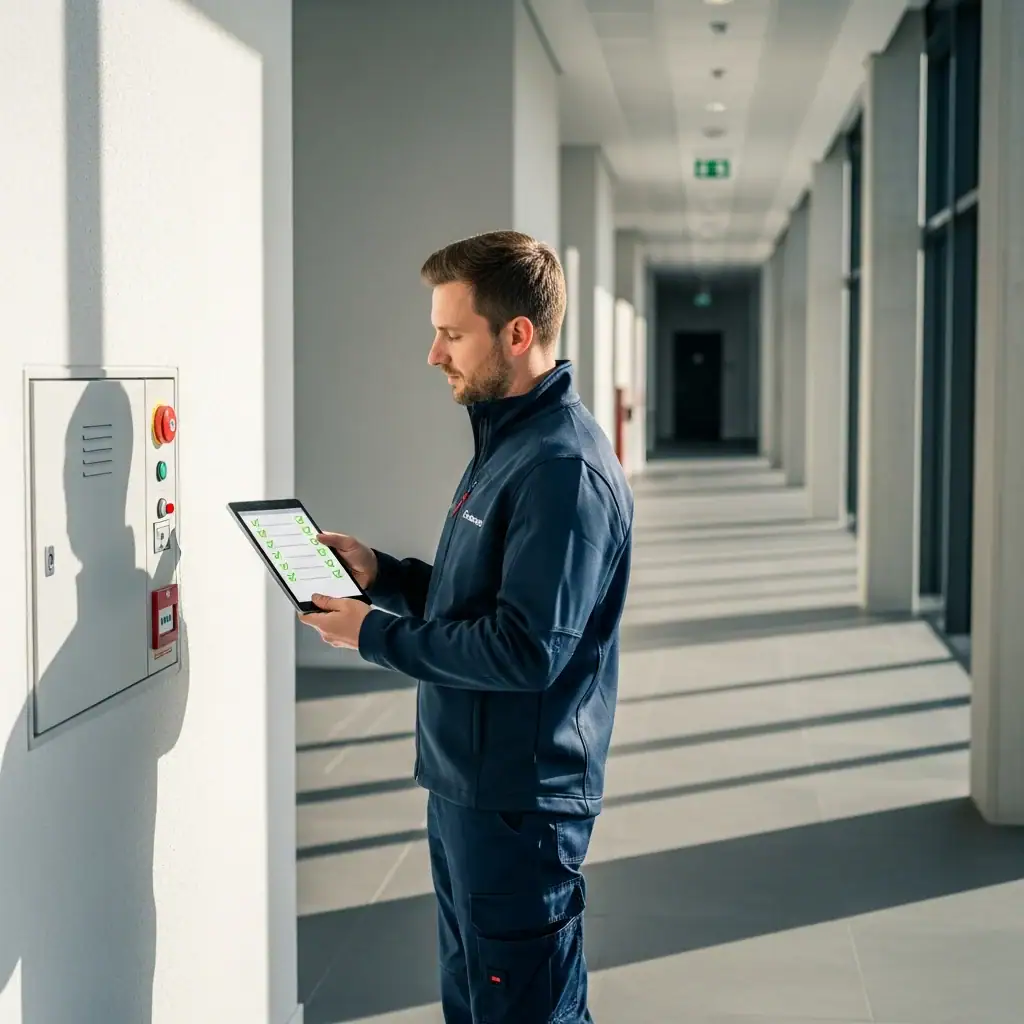
The operator obligations for a fire alarm system are extensive and extend across the entire lifecycle of the system. The most important obligation is to ensure the constant operational readiness of the BMA, including daily visual checks of the fire alarm control panel for operational indicators, fault or error messages. In accordance with DIN VDE 0833-1 and DIN 14675, regular inspections and servicing must also be carried out. Quarterly inspections, comprising visual and functional checks, can be carried out by instructed personnel of the operator. At least annual servicing, involving thorough testing and maintenance work, must be carried out by certified specialist firms. A further central aspect is the appointment and instruction of personnel: an instructed BMA person must be available on site at all times, to be able to operate the system. All processes, such as servicing, tests, fault rectification and the instruction of personnel, must be recorded without gaps in a logbook. This documentation obligation is essential, in order to be able to demonstrate fulfilment of the operator obligations in the event of a claim. In the event of BMA failure, suitable alternative measures, such as fire watches, must also be taken. The correct implementation of these core obligations is decisive for safety and for minimising liability risk.
Common mistakes and risks in failing to meet operator obligations
Failure to meet operator obligations for fire alarm systems carries considerable risks that extend far beyond technical shortcomings. A common mistake is inadequate or missing documentation of servicing and tests. This jeopardises not only the demonstration of legal compliance in the event of a claim, but can also lead to the loss of insurance cover. Insurers often require operation to DIN standards and regular servicing as a condition for full insurance cover. Overlooked fault messages at the fire alarm control panel, or ignoring recommendations from the servicing firm, are further typical failures that impair the system's functionality and can have fatal consequences in an emergency. Unclear responsibilities and inadequate instruction of personnel often lead to operating errors or delayed responses in an alarm situation. The legal consequences of breaching these obligations are severe. Alongside civil claims for damages, gross negligence or intent can also lead to criminal prosecution, which can extend to the personal responsibility of management. Business interruption, high property damage and reputational loss are further economic consequences. The complexity of the standards and the high effort required for inspection and servicing are often underestimated in practice, leading to a dangerous gap between the requirements and actual implementation.

The role of the external specialist for fire alarm systems (EFBMA)
Given the complexity and scope of operator obligations, many companies opt to commission an external specialist for fire alarm systems (externe Fachkraft für Brandmeldeanlagen, EFBMA). This expertise considerably relieves the operator and ensures that all requirements under DIN 14675, DIN VDE 0833 and VdS 2095 are met professionally and in a legally compliant manner. The EFBMA typically takes on the role of the responsible person for fire alarm systems, who must be appointed in accordance with DIN 14675-1. Their tasks include overseeing regular inspections and servicing, ensuring complete documentation in the logbook, coordinating with certified installer firms and the fire brigade, and providing advice on adjustments or extensions to the system. By delegating these tasks to a qualified external specialist, the operator minimises their own liability risk, since their obligations are reduced to selection and monitoring duties. The EFBMA brings not only current expertise in continually evolving standards and technologies, but also the necessary neutrality to give manufacturer-independent recommendations. This is particularly important when selecting servicing providers or evaluating offers for modernisation. Working with an EFBMA is thus a strategic decision that increases safety and contributes to efficiency and cost control in BMA operation.
Planning and selecting the right servicing and maintenance concept
An effective servicing and maintenance concept is the backbone of legally compliant, functional BMA operation. Planning begins with a detailed analysis of the existing system, its components, and the specific requirements of the building and its use. Here, the intervals for inspections, servicing and, where necessary, repairs are set, based on the requirements of DIN 14675 and DIN VDE 0833. Selecting the right provider for servicing and maintenance is decisive. Under DIN 14675, this work must be carried out by certified specialist firms with the necessary competence and experience. PLANATEL® supports operators in preparing specifications of services, evaluating offers, and selecting suitable certified installers. In doing so, we place value on manufacturer-independent criteria, in order to find an optimal solution that is not tied to specific products. A well-structured servicing contract should not only cover regular tests and maintenance measures, but also include clear provisions for fault rectification, response times, and the availability of spare parts. Forward-looking planning helps avoid unplanned failures and the associated costs, and secures the long-term operational safety of the fire alarm system.
Manufacturer-independence as the key to optimisation and cost control
Manufacturer-independence is a fundamental pillar of independent consulting and planning in the field of fire alarm systems. It enables operators to find the optimal solutions for their specific requirements, without being tied to the products or services of a single manufacturer. Many operators are unaware of the potential manufacturer dependency that can manifest itself in overpriced servicing contracts, restricted choice of spare parts, or unnecessary system changes. Manufacturer-independent consulting, such as that offered by PLANATEL® for over 34 years, analyses the market objectively and identifies the most economical, technically suitable options. This includes evaluating various BMA systems, selecting certified installers, and optimising servicing concepts. By avoiding manufacturer dependency, operators can not only reduce costs, but also increase the flexibility and future-proofing of their fire alarm systems. This is particularly relevant when modernising existing systems or integrating new technologies. Independent planning ensures that investments retain their value in the long term, and that the system meets current and future requirements. PLANATEL®'s financial independence guarantees that recommendations are always made in the customer's best interest, and that no hidden incentives influence decision-making. This creates trust and enables transparent, effective collaboration.
Next step
Contact us for a no-obligation initial consultation.
PLANATEL®: Independent planning and consulting since 1992
Tel: 040 / 23 73 02-30
Email: info@planatel.de
Frequently asked questions
What documentation obligations apply to operators of fire alarm systems?
Operators of fire alarm systems are required to keep a complete logbook. All relevant processes must be documented in it, including daily visual checks, quarterly inspections, annual servicing, fault rectification, changes to the system, alarm triggers, and the instruction of personnel. This documentation is decisive to be able to demonstrate compliance with the standards (e.g. DIN 14675, DIN VDE 0833) and to be legally protected in the event of a claim. Incomplete or missing documentation can jeopardise insurance cover and lead to liability risk.
How often must fire alarm systems be inspected and serviced?
In accordance with DIN VDE 0833-1 and DIN 14675, fire alarm systems must be checked regularly. This includes quarterly inspections, comprising visual and functional checks, which the operator can carry out through instructed personnel. In addition, at least annual servicing by a certified specialist firm is required. This servicing is more extensive and serves the thorough testing and maintenance of the system, in order to ensure its lasting operational readiness and functional safety.
What does manufacturer-independence mean in BMA consulting, and why does it matter?
Manufacturer-independence means that consulting and planning for fire alarm systems is carried out independently of the products or interests of individual manufacturers. This is decisive for developing objective, needs-based solutions that are not tied to specific brands. Manufacturer-independent consulting helps to avoid manufacturer dependency, which is often associated with higher costs, restricted flexibility, and suboptimal technical solutions. It enables the selection of the best components and service providers available on the market, which, in the long term, leads to cost optimisation and greater efficiency and future-proofing of the system.
What role does PLANATEL® play in consulting on operator obligations for fire alarm systems?
PLANATEL®, as an independent planning and consulting firm, offers comprehensive expertise on operator obligations for fire alarm systems. We analyse existing systems, assess compliance with normative requirements (DIN 14675, VdS 2095, DIN VDE 0833), and develop tailored concepts for legally compliant, efficient operation. Our manufacturer-independent positioning and more than 34 years of experience guarantee objective recommendations tailored to the customer's individual needs. We support the selection of certified installers and the optimisation of servicing concepts, to minimise liability risk and secure long-term value retention.
What are the consequences in the event of a fire if BMA operator obligations were neglected?
In the event of a fire and demonstrable neglect of BMA operator obligations, the consequences can be severe. Alongside the immediate danger to life and limb, the operator can face considerable civil claims for damages. Insurance cover may lapse in whole or in part, leading to high financial losses. In addition, regulatory fines are possible, and in cases of gross negligence or intent, even criminal investigations against the responsible members of management. The company's reputation suffers lasting damage from such incidents.
Which standards are relevant to operator obligations for fire alarm systems?
DIN 14675 (structure and operation of fire alarm systems), DIN VDE 0833-1 and -2 (hazard warning systems), and VdS 2095 (guidelines for automatic fire alarm systems) are the primary standards relevant to operator obligations for fire alarm systems. These standards and guidelines define the requirements for planning, installation, operation and servicing.
What happens if operator obligations for fire alarm systems are not met?
Failure to meet operator obligations can lead to considerable consequences, including the loss of insurance cover, fines, civil claims for damages, and, in the worst case, criminal prosecution in the event of personal injury. Business interruption and reputational loss are also possible.
What is the task of an external specialist for fire alarm systems (EFBMA)?
An external specialist for fire alarm systems (EFBMA) supports the operator in fulfilling their obligations. They oversee inspections and servicing, ensure documentation, coordinate with installers and the fire brigade, and advise on technical and normative questions. This minimises the operator's liability risk.
How can costs be optimised in operating fire alarm systems?
Costs can be optimised through manufacturer-independent planning and consulting, which enables the selection of the most economical, technically suitable systems and servicing concepts. Independent analysis helps to avoid manufacturer dependency and implement efficient, long-term solutions that meet requirements.
Sources and further information
- bma365.de
- rutte.de
- heinrich-brandmeldetechnik.de
- uds-beratung.de
- fm-connect.com