


Security Concepts & Threat Analyses12 min read
Strongroom Access Control: Strategic Planning for Maximum Security
Strongrooms hold a company's most critical assets and most sensitive data. Effective access control here is not merely a technical necessity but a strategic decision that determines the security and resilience of your entire organisation. Planning mistakes can have far-reaching financial and reputational consequences.
Strongroom access control is a multi-layered security system that governs physical access to high-security areas. It covers the identification, authentication and authorisation of individuals through mechanical, electronic or biometric methods, to prevent unauthorised entry and meet the legally compliant requirements for protecting sensitive assets.
Independent expertise for legally compliant, future-proof access solutions in high-security areas
Strongrooms hold a company's most critical assets and most sensitive data. Effective access control here is not merely a technical necessity but a strategic decision that determines the security and resilience of your entire organisation. Planning mistakes can have far-reaching financial and reputational consequences.
Key Takeaways
- Effective strongroom access control is essential to protect critical assets and data, requires a multi-layered security architecture, and must address both external and internal threats.
- Planning must be strictly legally compliant and take into account current standards such as DIN EN 1143-1, VdS guidelines, and regulatory requirements such as DORA (for financial institutions).
- Independent, manufacturer-independent consulting, as offered by PLANATEL®, is essential for developing a tailored, future-proof, cost-efficient solution that avoids manufacturer dependency and is optimally integrated into the overall security concept.
As both physical and digital threats steadily increase, strongrooms are of fundamental importance to companies, particularly in the financial sector and in critical infrastructure. They protect not only cash and precious metals but also highly sensitive data, intellectual property and critical IT infrastructure. Effectively controlling access to these areas is therefore not an option but a mandatory necessity. Inadequate strongroom access control can lead to substantial financial losses, data leaks and irreparable reputational damage. The complexity of the requirements calls for well-founded, manufacturer-independent planning.
The Critical Role of Strongrooms and the Need for Protection
Strongrooms are the physical heart of security for many organisations. They protect assets essential to a company's survival, from cash and securities, through physical data carriers holding sensitive information, to critical servers and specialist equipment. The need to protect these areas against unauthorised access is beyond question. Current threat analyses, such as the BaFin Risk Report 2025, show an increase in hybrid threats combining physical attacks and cybercrime, which can significantly endanger financial stability. ATM bombings, which caused loot damage of €28.4 million in 2023, illustrate the continued relevance of physical attacks.
In addition, internal threats such as economic crime and breach of trust are a risk not to be underestimated, with a high proportion of perpetrators coming from within the company itself. Robust strongroom access control must therefore not only fend off external attackers but also minimise internal risk. Planning such systems requires a deep understanding of the specific assets to be protected and the potential attack vectors. The aim is to create an environment where only authorised individuals gain access, at defined times and under controlled conditions, to guarantee the integrity and confidentiality of the protected assets.
Legally Compliant Design: Standards and Guidelines for Access Control
Planning strongroom access control must take into account a wide range of national and European standards as well as sector-specific guidelines, to guarantee legal compliance. DIN EN 1143-1 plays a central role here, setting requirements, classification and test methods for the burglary resistance of value containers such as strongboxes, strongroom doors and strongrooms. The resistance grade (RG) under this standard is decisive for classifying burglary resistance and significantly affects insurable values. In addition, the VdS guidelines VdS 2450 for strongroom doors and enclosures and VdS 2451 for strongrooms of solid, modular or mixed construction are based on this European standard and give it concrete form.
For the access control systems themselves, the VdS guidelines VdS 2358 (requirements), VdS 2359 (test methods) and VdS 2367 (planning and installation) are authoritative. In the context of intrusion detection systems (EMA), which are often coupled with access control systems, DIN VDE 0833-3 is relevant, setting out provisions for EMA/holdup alarm systems and defining security grades (Grade 1 to 4) under DIN EN 50131-1. Financial institutions are also subject to BaFin's banking supervisory requirements, which will be progressively replaced by the European Digital Operational Resilience Act (DORA) from January 2025. DORA sets out extensive obligations for ICT risk management and emphasises the need for robust security measures against physical and digital threats. In Austria, the Resilience of Critical Entities Act (RKEG) also comes into force on 1 March 2026, obliging critical entities to secure their sites against physical threats. Independent planning ensures that all relevant regulations are taken into account from the outset.
The Architecture of Modern Access Control Systems for High-Security Areas
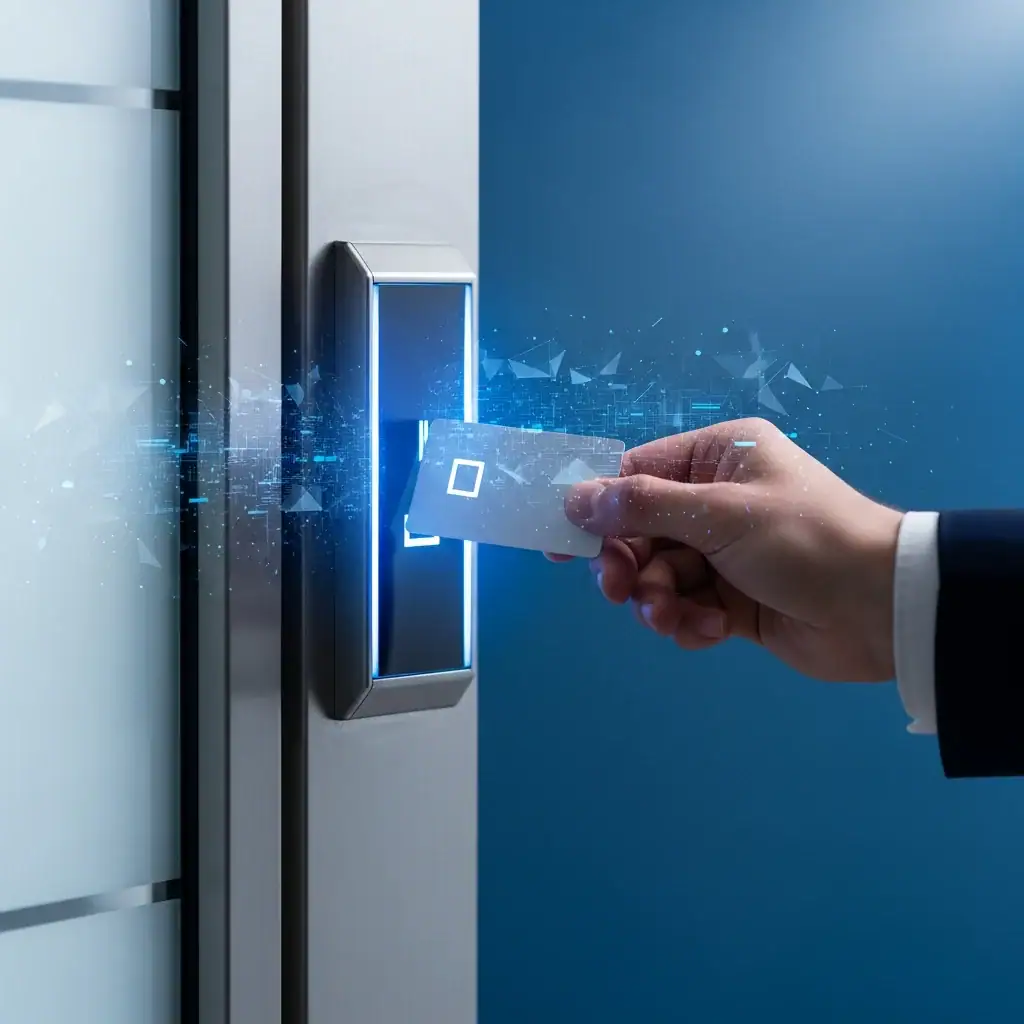
Modern access control systems for strongrooms are highly complex architectures that go far beyond simple keys. They are based on the principle of identification, authentication and authorisation, to ensure that only authorised individuals gain access at specific times. The core components include readers (for cards, transponders, biometric characteristics), controllers that make access decisions, and identification media. In high-security areas in particular, multi-factor authentication (MFA) is essential. MFA requires identity to be confirmed by at least two independent factors, for example a combination of knowledge (PIN), possession (transponder card) and inherence (a biometric characteristic such as a fingerprint or vein scan). Studies show that MFA can block up to 99.9% of identity-based attacks.
Biometric methods, such as fingerprint or vein-pattern recognition, offer a high degree of forgery resistance and are hard to bypass. They can be combined with RFID readers or PIN keypads to achieve particularly high security standards. The systems must also be flexible enough to define role-based access rights that can be adapted by department, role or security area, and that can also integrate visitor management systems. Complete logging of all access attempts, both authorised and unauthorised, is essential for audit-proof record-keeping and forensic analysis in the event of an incident. Selecting and configuring these components requires specialist knowledge in order to develop a tailored, effective solution that meets individual protection needs.
The Strategic Planning Process: From Analysis to Manufacturer-Independent Design
Successfully implementing strongroom access control begins with a strategic, structured planning process. PLANATEL® follows a proven approach here, putting each customer's specific requirements and risk profile at the centre. The process starts with a detailed as-is survey and needs analysis, precisely analysing the existing infrastructure, the assets to be protected, potential threats and operational processes. This also includes a detailed risk analysis assessing both internal and external threats, of the kind described, for example, in the BaFin Risk Report 2025 for the financial sector.
Based on these findings, a target concept is developed, defining the optimal technical and organisational measures. Here we place the greatest importance on manufacturer independence and financial independence, to guarantee the best possible solution free of any commissions or ties to particular providers. This protects our customers from unnecessary manufacturer dependency and enables a cost-efficient, flexible system architecture over the long term. Detailed planning includes selecting suitable technologies and components, preparing specifications of services, and preparing the tender and award. PLANATEL® supports the entire process through to implementation support, acceptance and final invoice review, to ensure the planned solution meets the highest quality and security standards and that the investment is put to optimal use.
Integration and Synergies: Access Control Within a Holistic Security Concept
Looking at strongroom access control in isolation falls short. For maximum security, thorough integration into a holistic security concept is essential. This creates synergies and increases the overall efficiency of the security architecture. Access control should be closely networked with other security systems, such as intrusion detection systems (EMA) and video surveillance systems. In the event of an unauthorised access attempt, the access control system can automatically send an alarm to the EMA, which in turn triggers an immediate response and simultaneously activates video surveillance to document the incident.
In addition, connecting to a central security management system (PSIM) is advantageous. A PSIM consolidates information from various security systems and provides a unified interface for monitoring, control and response to security events. This enables a faster, more coordinated response to incidents and streamlines operations. Integration into higher-level IT systems, such as ERP systems or databases, can also be useful, for example, to automatically manage access authorisations based on employee status or project affiliation. Planning such interfaces requires deep technical understanding and the ability to oversee complex system landscapes. PLANATEL® helps companies make full use of these integration opportunities and create a coherent, high-performing security infrastructure that intelligently connects all relevant systems.
Future-Proof Strongroom Access Control: Challenges and Independent Expertise
The security threat landscape is constantly evolving, requiring continuous adaptation and development of strongroom access control. Future developments include the greater use of advanced biometrics, such as multi-modal biometrics, and the integration of artificial intelligence (AI) for anomaly detection and predictive analysis of access patterns. The use of blockchain technologies could also play a role in the future in the tamper-proof administration of access authorisations. At the same time, companies face challenges such as ensuring system scalability, defending against increasingly sophisticated cyberattacks that can also affect physical systems, and avoiding manufacturer dependency, which hinders innovation and cost optimisation.
Common mistakes in implementation include an inadequate risk analysis, neglecting organisational measures, a lack of holistic consideration of the security architecture, and selecting systems that are not future-proof or flexible enough. This is where PLANATEL®'s independent expertise comes in. With more than 34 years of experience planning and advising on security systems, we offer a manufacturer-independent perspective oriented solely towards our customers' needs. We help you master these challenges, select the right technologies, minimise risk, and develop a long-term, viable security strategy. Our consulting ensures that your investment in strongroom access control is used optimally and that your company can withstand future threats.
Next Step
Contact us for a no-obligation initial consultation.
PLANATEL®: Independent planning and consulting since 1992
Tel: 040 / 23 73 02-30
E-Mail: info@planatel.de
Frequently Asked Questions
What types of access control systems exist for strongrooms, and which are most secure?
Mechanical, electronic and biometric access control systems are used for strongrooms. Mechanical systems are based on locks and keys. Electronic systems use cards, transponders or codes. Biometric systems identify individuals by unique physical characteristics such as fingerprints or vein patterns. Hybrid systems that combine multi-factor authentication with biometric methods are generally the most secure, as they offer very high forgery resistance and are hard to bypass. The choice depends on the strongroom's resistance grade and its protection needs.
How can access control help reduce internal security risk?
Precise access control reduces internal security risk by restricting access to strongrooms to authorised personnel and keeping detailed logs of every access attempt. Role-based authorisations make it possible to define exactly who may enter which area and when. The four-eyes principle, or two-person access control, can be implemented for particularly sensitive areas. In the event of suspicious activity or unauthorised access attempts, an alarm is triggered immediately, increasing traceability and deterring or identifying potential perpetrators.
What advantages does integrating access control into a security management system offer?
Integrating access control into a security management system (PSIM) creates a central monitoring and control platform for all security systems. This enables a faster, more coordinated response to security events, since alarms and information from various sources (e.g. access control, intrusion detection systems, video surveillance) converge in one place. The PSIM can trigger automated processes in response to specific events, such as locking doors or activating cameras, and provides comprehensive documentation for forensic analysis.
How does PLANATEL® support companies in planning strongroom access control?
PLANATEL® supports companies as an independent planning and consulting firm with more than 34 years of experience. We begin with a detailed needs and risk analysis, develop a tailored, manufacturer-independent target concept, and support the entire process from tender to acceptance. Our focus is on creating legally compliant, future-proof, cost-efficient solutions that are optimally integrated into the existing infrastructure and avoid manufacturer dependency. We plan maintenance concepts and select certified installers.
What role do biometric systems play in access control for strongrooms?
Biometric systems play an increasingly important role in access control for strongrooms, as they offer high security and forgery resistance. Methods such as fingerprint, vein or iris scans identify individuals by unique physical characteristics that are hard to manipulate or steal. Combined with other authentication factors (multi-factor authentication), they significantly increase protection against unauthorised entry and are particularly suited to high-security areas with the highest identification requirements.
Which standards are relevant to strongrooms?
DIN EN 1143-1 is primarily relevant to strongrooms, classifying burglary resistance. In addition, there are VdS guidelines such as VdS 2450 for strongroom doors and VdS 2451 for strongrooms of solid, modular or mixed construction. These standards define resistance grades and test methods that are decisive for security and insurability.
What does multi-factor authentication (MFA) mean in the context of strongrooms?
MFA means that at least two independent authentication factors are required to access the strongroom. This can be a combination of something you know (a PIN), something you have (a transponder card), and something you are (a biometric characteristic such as a fingerprint or vein scan). MFA significantly increases security by making it considerably harder for attackers to defeat the system.
What role does BaFin play in access control for financial institutions?
BaFin sets high requirements for the information and physical security of financial institutions. From January 2025, the Digital Operational Resilience Act (DORA) will progressively replace the existing BAIT requirements. DORA sets out extensive obligations for ICT risk management, which also affect physical security and therefore access control to strongrooms, in order to strengthen resilience against hybrid threats.
Why is manufacturer independence important when planning access control systems?
Manufacturer independence ensures that the planned solution is optimally tailored to the company's specific needs and is not influenced by the interests of a particular provider. It avoids manufacturer dependency, allows selection of the best technologies on the market, promotes cost optimisation, and secures the system's long-term flexibility and scalability. Independent advisers such as PLANATEL® offer this neutrality.
Sources and Further Information
- VdS 2227 – Intrusion Detection Systems
- Guidelines for the recognition of strongrooms of solid construction – Verband der Sicherheitsunternehmen Österreichs – VSÖ
- TRVE 10-4 guideline for strongboxes and strongrooms for storing weapons – KFV – Kuratorium für Verkehrssicherheit
- Vault security levels, certification – CLAVIS – wertschutzraum.de
- Strongroom doors | Security technology | Doors for special applications – BauNetz Wissen